


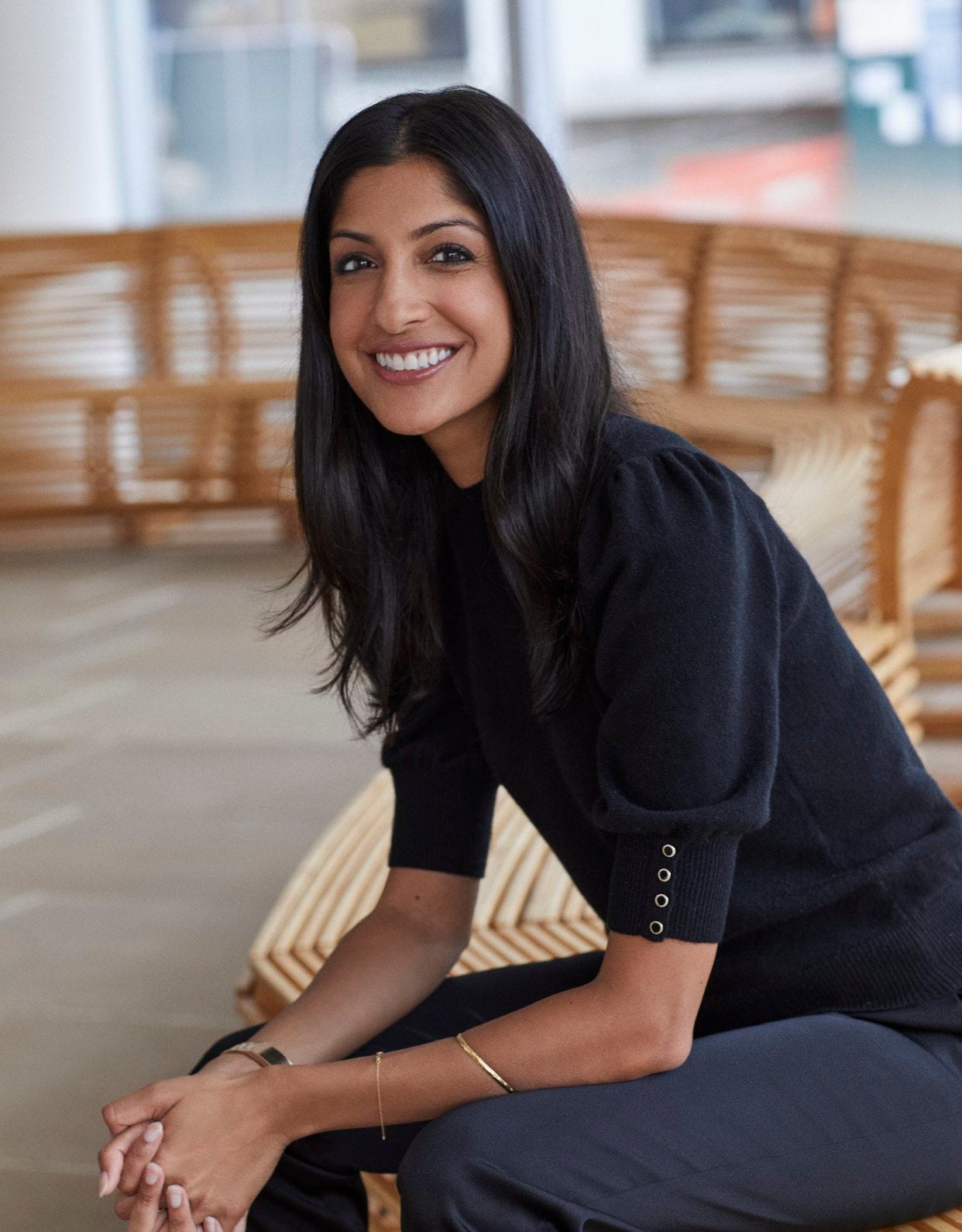
From Flint to the Fortune 500
There is a particular kind of ambition that is forged in awareness and understanding, that the world does not automatically open its doors for you. For Anjali Sud, that awareness was shaped in Flint, Michigan, a city that would become as much a part of her story as any boardroom or business school she later attended.
Born in Detroit to Punjabi immigrants from India, Sud grew up in Flint in a family that believed in the power of business to create a positive impact. Her parents were physicians, but their ambitions extended beyond medicine. From the time Sud can remember as a child, her father’s passion was entrepreneurship. Even though he was a physician, he also started a plastics recycling plant in Flint that still operates today. He held the philosophy that if you really want to influence people’s lives at scale, business is a powerful vehicle to do so.
Her father would place clips from Wall Street Journal articles about CEOs on her pillow for her to find when she went to sleep, sending the message: “I grew up with parents who believed I could be the person in that clip.” It was a quiet, persistent form of encouragement, a daily act of belief from a family that had sacrificed everything to plant their roots in American soil.
Growing up in Flint also gave Sud a ground-level education in what business failure looks like in real communities, a lesson that would later shape her conviction that leadership must serve people, not just shareholders.
Building the Foundation: Amazon, Time Warner, and the Art of Learning
At age 14, Sud left Flint for Phillips Academy Andover, an elite boarding school in Massachusetts. After Phillips, she earned a Bachelor of Science in Finance and Management from the University of Pennsylvania’s Wharton School, then an MBA from Harvard Business School in 2011. By any conventional measure, the credentials were impeccable. Yet when she began applying to investment banks, every major firm turned her down. The rejection that would have derailed many simply redirected her.
Rather than mourn the closed doors of finance, Sud took a deliberately winding path through media and technology, starting as an M&A analyst at Sagent Advisors, then moving into mergers and acquisitions at Time Warner, and eventually landing at Amazon in a marketing and category lead role. At Amazon, she absorbed the company’s relentless customer obsession, its culture of bold experimentation, and its willingness to play a long game.
Each role was chosen not for prestige, but for what it could teach her. As she later put it:
“I thought, ‘No one’s going to create a career path for me. I need to create my own.’ I went from being a toy buyer to being a marketer to selling diapers online to running a global video platform.” - Anjali Sud
That nonlinear trajectory was not a detour — it was her education.
The Vimeo Bet: Seeing Opportunity Where Others Saw Defeat
In 2014, Sud joined Vimeo as Head of Global Marketing. At the time, the company was trying and failing to compete with streaming giants like Netflix. Most people would have written it off. Anjali saw a different kind of opportunity.
What she saw, and what others missed, was that Vimeo’s true value had nothing to do with out-entertaining Netflix. Its value was in the tools it provided to the creators, the professional videographers, small business owners, and storytellers, who needed a reliable, high-quality platform. The audience wars were already lost. But the creator economy was just beginning.
Sud joined Vimeo, an IAC subsidiary, in July 2014 as Head of Global Marketing. She was promoted to General Manager of Vimeo’s core creator business and then became CEO in July 2017 at age 33.
Becoming CEO at 33 was not a moment Sud had anticipated. “People often ask me about what I did to become the CEO of Vimeo. The truth is, until the minute that the job was offered to me, it never even occurred to me that it was a possibility.”
"I saw an opportunity to champion the creator side of the platform. So, I just started doing it. That really opened up a path for me to do that formally. It was a major catalyst for why I'm sitting where I am today. You just have to permit yourself and not wait for formal permission to do it."
— Anjali Sud
But the groundwork had been quietly laid through a leadership strategy that she practiced from day one: obsessive customer listening.“When I got to Vimeo, I was in a VP of marketing role, very middle management — so my first task was to understand our customers. I spent a lot of time talking to the humans that we served and listening. Every year at Vimeo, I knew job number one was to keep talking to customers and to have a pulse on what mattered to them.”
This was not performative stakeholder engagement. It was strategic intelligence-gathering that informed every major decision she would make as CEO.
The Great Pivot: From Entertainment Platform to Video SaaS
Once in the CEO seat, Sud made one of the most audacious strategic pivots in modern media history. She walked away from the content arms race entirely.
She was appointed CEO of Vimeo in July 2017, as the company announced its plans to refocus its strategy from investing in original content to offering software and tools for video creators.
As Sud explained, “We pivoted away from being a viewing destination or media platform, like Facebook or YouTube or Netflix, and really into a video SaaS or software company for businesses.”
The move was counterintuitive. The industry was pouring billions into original programming. Sud was doing the opposite, stripping Vimeo down to its functional essence and rebuilding it as infrastructure for creators. Critics were skeptical. But the numbers told a different story.
In September 2017, she oversaw the acquisition of Livestream. In April 2019, she oversaw the acquisition of video editing app Magisto. In November 2021, she oversaw the acquisitions of video software startups WIREWAX and Wibbitz. Each acquisition was a deliberate expansion of Vimeo’s toolkit, not its content library.
The pivot worked. Under her leadership, Vimeo expanded rapidly and went public in 2021 with a $6 billion valuation. During her six-year tenure, she took the company public and established Vimeo as the home for video creators and professionals worldwide, building a community of over 300 million users.
This was leadership through strategic conviction, the willingness to be wrong in the short term to be right in the long term.
The End of One Chapter, the Beginning of Another
After nearly a decade at Vimeo, six years as CEO, Sud had accomplished something rare: she had taken a struggling, directionless company, reimagined its entire reason for being, and guided it to a public market debut worth billions. By any measure, it was a complete story.
But by 2023, the chapter was closing on its own terms. After nine years at Vimeo and six years as CEO, Sud announced on July 5, 2023, that she would be departing the company in September 2023 to pursue another opportunity. The SaaS transformation she had pioneered was maturing, and the company’s next phase was one of operational consolidation rather than strategic reinvention, no longer aligned with what Sud does best.
She is, at her core, a builder. And the most honest builders know when the building is done.
What she was looking for next was a new problem worthy of her particular skill set. The question she was asking, she later said, was not what’s the safest next move? But where is the biggest opportunity hiding in plain sight?
The answer was Tubi, a free, ad-supported streaming service owned by Fox Corporation that offers over 300,000 movies and TV shows with no subscription fees required.
“We are witnessing a seismic shift in where and how content will be consumed, and I believe Tubi can become the destination for the next generation of audiences,” said Sud. “The future of streaming TV is free, and I am excited to join the Tubi team to help shape the next wave of entertainment, giving all people access to all the world’s stories. Tubi is doing things differently in a space that is being imminently disrupted, and that is my kind of opportunity.”
That last phrase — “that is my kind of opportunity “— is the key to understanding her decision. Tubi wasn’t the obvious, prestigious, or safe choice. It wasn’t a household name in the way Netflix or Disney+ were. But it had something more valuable to Sud than brand recognition: a structural advantage the rest of the industry was too committed to its existing models to see.
Most leaders in her position would have taken time off or waited for the perfect next move. She didn’t. That same year, she joined Tubi as CEO. The speed of the transition was itself a statement. She was following the logic of her own convictions directly to the next place they led.
Tubi and the Billion-Dollar Proof
The results at Tubi have vindicated Sud’s instincts with remarkable speed. While user growth exploded from 64 million in February 2023 to 97 million by the end of 2024, profitability has arrived earlier than expected. Tubi generated $1.1 billion in fiscal year 2025 revenue and closed its second consecutive EBITDA-profitable quarter at the end of last year, powered by 19% year-over-year revenue growth and a 27% surge in user engagement.
In June 2025, Tubi announced that it had crossed 100 million monthly active users, over $1 billion in annual revenue, and an all-time high share of television viewing in the U.S.
The platform’s audience demographics are also telling. Tubi’s audience, 77% of which doesn’t have cable TV, skews toward millennials, Gen Z, and females, with more than 34% between the ages of 18 and 34. These are precisely the viewers the traditional Hollywood model has struggled to reach — and they are exactly who Sud built Tubi for.
The Boardrooms, the Honors, and the Bigger Platform
As her operational record has grown, so has her platform for influence.
Sud sits on the board of Sirius XM and Dolby Laboratories and is chair of the board of Change.org. She is a designated Young Global Leader of the World Economic Forum and a Henry Crown Fellow at the Aspen Institute. In May 2025, Sud was elected to serve on Harvard University’s Board of Overseers, filling a vacancy left by Canadian Prime Minister Mark Carney.
She uses these platforms not to collect titles, but to advocate for the ideas that animate her career: that entertainment should be accessible to everyone, that diverse storytelling reflects the diversity of the world, and that the next generation of leaders need not fit a preexisting mold.
At Pace University’s 2025 commencement, Sud urged graduates to pursue impact, embrace authenticity, and lead with boldness in a rapidly changing world.
“The way to create enduring value in the world is to build tangible things. Ideas are powerful, but impact comes from real products that help real humans. Surround yourself with optimists. If you look across every technologist, entrepreneur, or innovator you admire — across all personalities, styles, mantras, philosophies, you’ll find that they all have this trait in common.”
— Anjali Sud
The Architecture of a Career
What makes Anjali Sud’s story worth studying is not simply that she became a CEO twice before 45, or that she built a billion-dollar company, or that she navigated the chaos of modern media with apparent ease. It’s the architecture of how she did it.
She chose learning over prestige in her early career. She listened to customers before she formed opinions. She made bold strategic pivots and held them through skepticism. She built teams that looked like the audiences they served. She led with transparency when opacity would have been safer. And she bet on herself, repeatedly and unapologetically, in a world that did not always bet on her first.
As she put it:
“The thing I’ve learned is that you can create your own opportunities, and we can all reinvent ourselves at any stage in our careers.”
If this was useful, please share it with anyone who needs to hear it.
New Article drops every Tuesday.
Be Bold. Be Real. Be Anomalous.
Follow for more Be Anomalous stories, conversations, and behind-the-scenes.
Website | Instagram | LinkedIn | YouTube | @iamsaimenon