


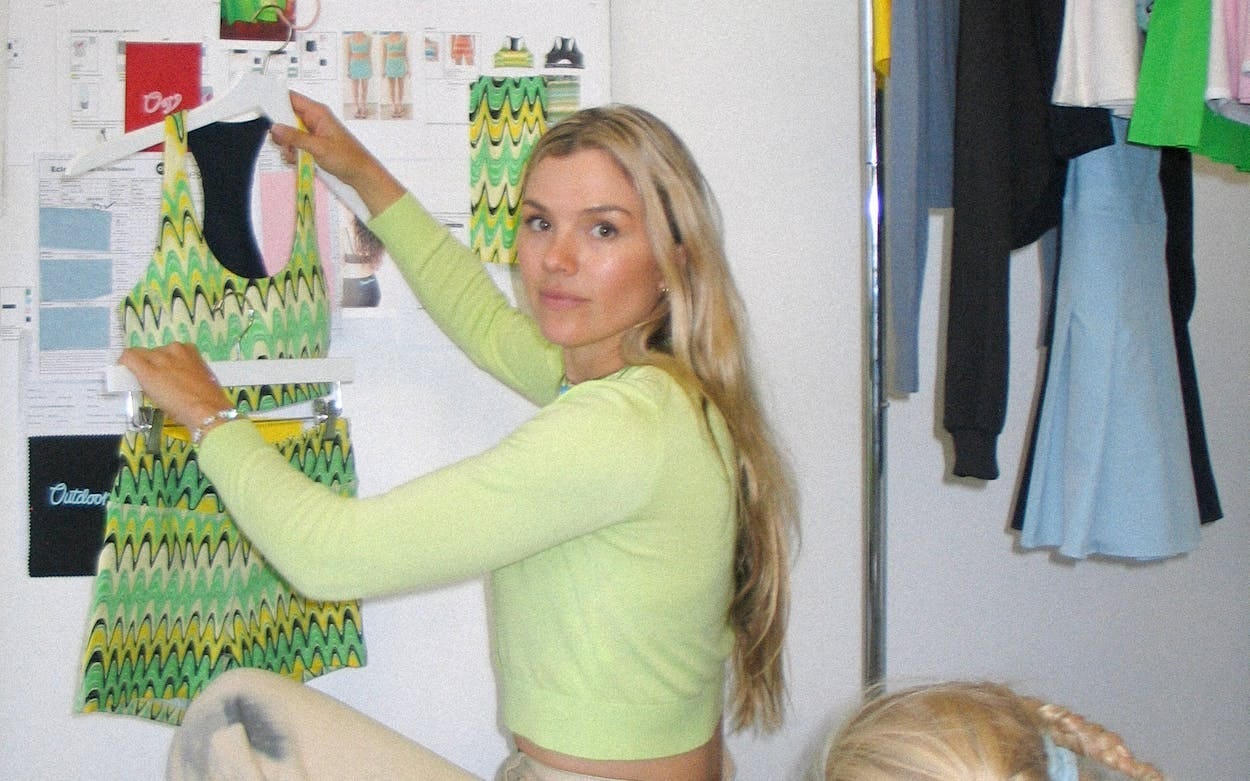
In February 2020, Ty Haney said goodbye to the company she founded on Slack. She was 31. She had built Outdoor Voices from a concept sketched out at Parsons School of Design into a $110 million activewear brand, raised over $64 million in venture capital, opened stores across the country, landed magazine covers, and built a community of genuinely devoted customers around the radical idea that movement should be joyful, not performative. “Doing Things” wasn’t just a tagline. It was a cultural posture that resonated with a generation tired of fitness culture’s punishment-and-discipline aesthetic.
She typed out her goodbye message and hit send.
She still owned 10% of the company she had created.
How do you go from founder to owning 10%
Outdoor Voices didn’t fail because of bad press or a difficult founder personality, though both became part of the story. It failed structurally, and the structure was set years before anyone wrote an unflattering article about Haney or before the board decided she needed to go.
Here’s what actually happened, round by round.
When Haney launched Outdoor Voices, she needed capital to turn her vision into a real company, including inventory, manufacturing, branding, and a team. She raised seed funding, then a Series A, then more. Each round felt like validation. Each new investor felt like a partner who believed in what she was building. In legal terms, each round was a transaction: cash in exchange for a piece of the company. Do that enough times, and the pieces add up. Your 100% drops to 80%, then 60%, and so on. This is dilution, and it’s not inherently bad.
Dilution is the cost of capital, and capital builds real things.
But dilution does something beyond shrinking your ownership percentage. It shifts voting power. It fills a board with people who backed the company financially but didn’t build it, people whose job is to protect their investment, not to steward a creative vision. By the time Haney’s conflict with her board came to a head in early 2020, her investor group, led by General Catalyst and Forerunner Ventures, with retail legend Mickey Drexler installed as chairman, controlled the board entirely. Haney owned 10%. When they decided she needed to leave, there was no mechanism for her to resist. She didn’t have the votes. She didn’t have the leverage. She had the vision, the community, the taste, the relationships that made the brand what it was, and none of that appears anywhere on a cap table.
What the board saw versus what the brand was
This is where the story gets complicated in a way that doesn’t fit into villain-and-victim framing.
Mickey Drexler was not a bad bet. He was one of the most accomplished retail executives in American history, the man who transformed Gap and rebuilt J.Crew. His instincts about retail operations, unit economics, and scaling a consumer brand were genuinely world-class. When he looked at Outdoor Voices, he saw real problems: the company was spending heavily, profitability was distant, and some of Haney’s leadership decisions were creating organizational friction. From a conventional retail-building perspective, his concerns weren’t wrong.
But Outdoor Voices was not a conventional retail company. It was a community-first brand that had grown precisely because it wasn’t optimizing for the metrics that traditional retail optimizes for. Its customers weren’t just buying leggings, they were buying membership in a movement, an identity, a sensibility. That’s harder to measure and much harder to hand off. The brand’s value lived inside Haney: in her aesthetic instincts, her relationship with the community she’d built, and her ability to make people feel that Outdoor Voices understood how they wanted to live. Strip that out, and you don’t have a $110 million company anymore. You have inventory and leases.
The board saw a founder who was difficult to manage and a business with financial problems. They made a decision that made sense within their framework. What they miscalculated was that in a founder-identity brand, removing the founder doesn’t solve the problem; it becomes the problem.
What happened after she left
Outdoor Voices did not recover under new leadership. The brand that had built its entire identity around an authentic, anti-performance-culture voice struggled to sustain that voice without the person who had originated it. The community Haney had cultivated started to dissipate. The business continued to deteriorate, losing reported estimates of up to $2 million a month at its worst. By March 2024, the company closed all 16 of its retail stores and went online-only.
That same month, former employees confirmed the company was preparing a Chapter 11 filing. Instead, in June 2024, private equity firm Consortium Brand Partners stepped in and acquired the brand for an undisclosed sum, effectively a distressed sale of an asset that had once been valued at $110 million.
The brand that had defined a moment in DTC retail had changed hands at what was almost certainly a fraction of its peak value.
The return
In 2025, Haney came back not as an employee, not as a figurehead, but as founder, partner, and co-owner, with a negotiated stake that gave her real governance rights alongside a new ownership structure. The terms of her return reflected everything she had learned the hard way the first time.
She was direct about the lesson: “I learned the hard way that ownership really matters. The first goal put me in a position where I was diluted to the point that I lost control, so that is something I prioritized in my companies since.”
And on fundraising specifically: “I’ve become a lot more sophisticated, or precise, in terms of who I raise money from, how much money I raise, and ultimately considerate of ownership and as little dilution as possible.”
She also said something about the new version of the business that contains more wisdom than it first appears: “The way that we’ve funded and structured OV doesn’t require that it needs to be massive overnight. The model has changed, and the model today requires being more mindful of profitability.”
Read that sentence carefully. “Doesn’t require that it needs to be massive overnight”. It’s a recognition that the growth-at-all-costs imperative raises more, spends more, scales faster, and is itself a control mechanism. When your business model requires constant outside capital to survive, you are always at the mercy of the people providing that capital. Reduce that dependency, and you get something back: the ability to make decisions based on what’s right for the brand instead of what satisfies the next round’s narrative.
The structural lesson
The Outdoor Voices story is often told as a human drama, a difficult founder, a frustrated board, and bad press at the wrong moment. That framing is more compelling and less useful than the actual lesson.
The actual lesson is that Haney was operating without structural protection from the moment she diluted past a threshold that gave her board control. Everything else happened downstream of that. The outcome was determined not in February 2020 when she sent the Slack message, but years earlier, in the accumulation of funding rounds she didn’t fully understand the governance implications of, like many founders.
Some tools could have changed this. Dual-class share structures, where founders hold shares with 10 votes each versus 1 vote per investor share, allow founders to retain voting control even as their economic ownership is diluted. Protective provisions, contractual clauses that require founder consent for specific decisions like replacing the CEO, can be built into investor agreements
And foundational to all of it: you need to know your cap table with precision at every moment, not approximately. Who owns what? Who has board seats? Who has the votes when a decision gets forced? Not your lawyer’s job to track and tell you. Yours.
Ty Haney was not oblivious. She was just a founder, like most founders, who learned from experience.
Related Content:
Ty Haney Built a $100M Brand... Then Walked Away | SOCIAL CURRENCY PODCAST 001
The Brutal Fall of a $100M Brand & the Woman Behind It | Ty Haney of Outdoor Voices
5 Years After Being Pushed Out of Outdoor Voices, Ty Haney Is Doing Things Again
Follow for more Be Anomalous stories, conversations, and behind-the-scenes.
Website | Instagram | LinkedIn | YouTube | @iamsaimenon