


RXBAR, Stripe, and Shopify sold three different things to three different buyers. Their first customers came from the same kind of place.
Try to find the names of RXBAR’s first ten customers. Then try Shopify’s. You won’t get far. Stripe’s history gives you one name and then a number.
These companies went on to be worth billions, and nobody kept the list. At the time, there was no reason to. The first customers didn’t look like history. They looked like a guy walking into a gym with protein bars in Tupperware, two brothers asking to borrow someone’s laptop, and a burnt-out programmer whose first customer was his own snowboard shop.
If your own first customers feel that small, you are in very good company.
Under the Hood is a Be Anomalous series for people in the hard, unglamorous middle of building something. Subscribe to get the next one in your inbox.
Every founder asks some version of the same question: how do I reach my market? It’s the wrong question for customer number one. None of these three companies reached a market. Each one found a single room and took the hardest part of saying yes off the customer’s plate.
The rooms looked nothing alike. That is what makes them useful.
“Just Sell a Thousand Bars”
RXBAR, selling a physical product
In 2012, Peter Rahal and Jared Smith were in the kitchen of Rahal’s parents’ home in Glen Ellyn, Illinois, making bars and talking about raising money. Rahal’s father, whose family ran a food manufacturing business, had heard enough.
As Rahal later summarized it: “You guys need to shut the fuck up and just sell a thousand bars.”
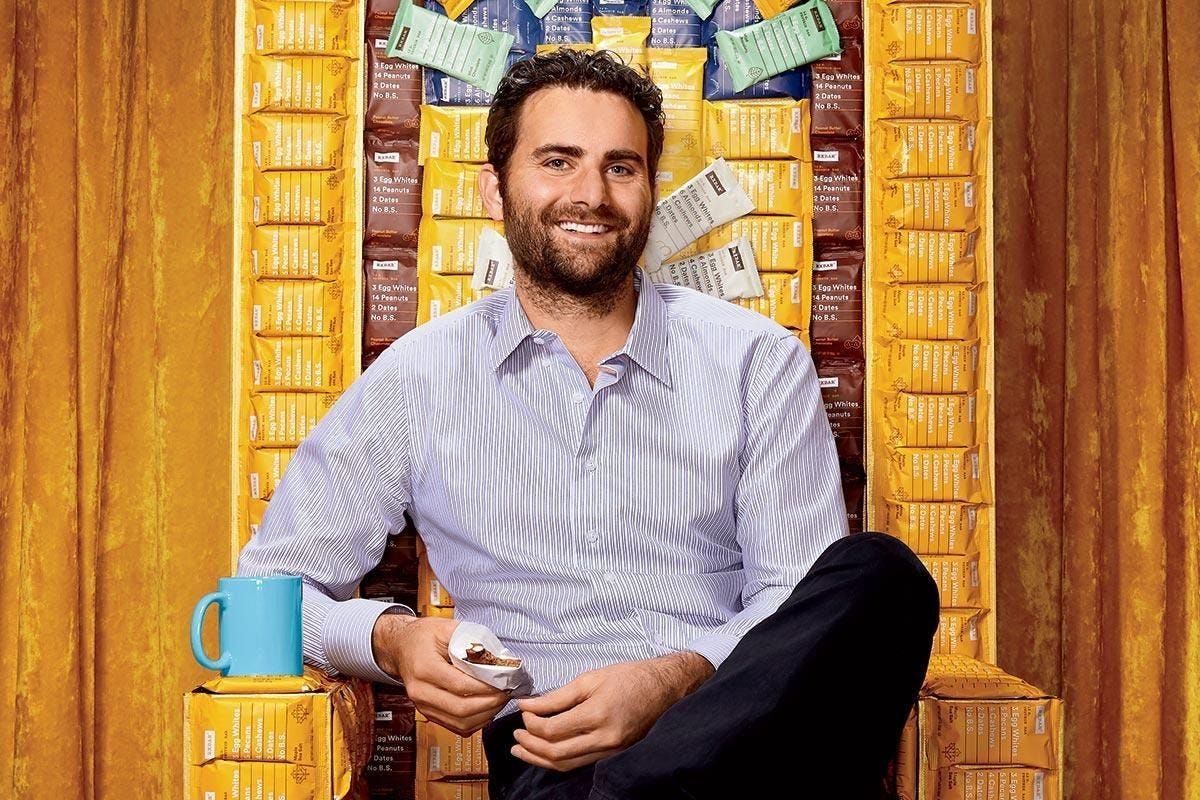
The obvious place to sell them was also impossible. The grocery aisle was crowded, and people kept telling Rahal the world didn’t need another protein bar. But he was a CrossFit regular, and his gym sold water and T-shirts, not bars. CrossFit members also ate paleo, which ruled out most of what was on the market.
So RXBAR’s first customers weren’t eaters at all. They were gym owners.
Rahal started in Chicago, dropping by gyms, calling and emailing. Then came Milwaukee, Minneapolis, and Indianapolis, and still nothing but gyms. He later described the numbers that convinced him: around 80 bars a week at a CrossFit box, against a handful at a convenience store. One gym owner saying yes was a data point. A bar selling at that rate meant every other gym in the country was a lead.
The operation looked like what it was. The packaging was built in PowerPoint, and Rahal’s mother helped put labels on the bars. Rahal’s own cell number was printed on the package for the first two years, so a gym owner could reorder online, by text, by call, or by email, whichever was easiest.
All that time in the field produced the thing that later made the brand. Sampling at events, the team kept having to answer the same question: what is it? They landed on a plain answer, listing out the egg whites, almonds, cashews, and dates. People lit up. When RXBAR redesigned in 2015, that sentence became the front of the package. Trade shows had ignored the company before that; afterward came Wegmans, Whole Foods, and then national coverage at Trader Joe’s.
The iconic label wasn’t dreamed up by an agency. It was a sales pitch, tested thousands of times on people holding a bar.
Kellogg bought the company in 2017 for $600 million.
“Give Me Your Laptop”
Stripe, onboarding businesses to software
A payments API has the opposite problem from a protein bar. Anyone can taste a bar in ten seconds. Trying payments software means a developer has to stop what they’re doing and integrate it, which is exactly the task every startup puts off.
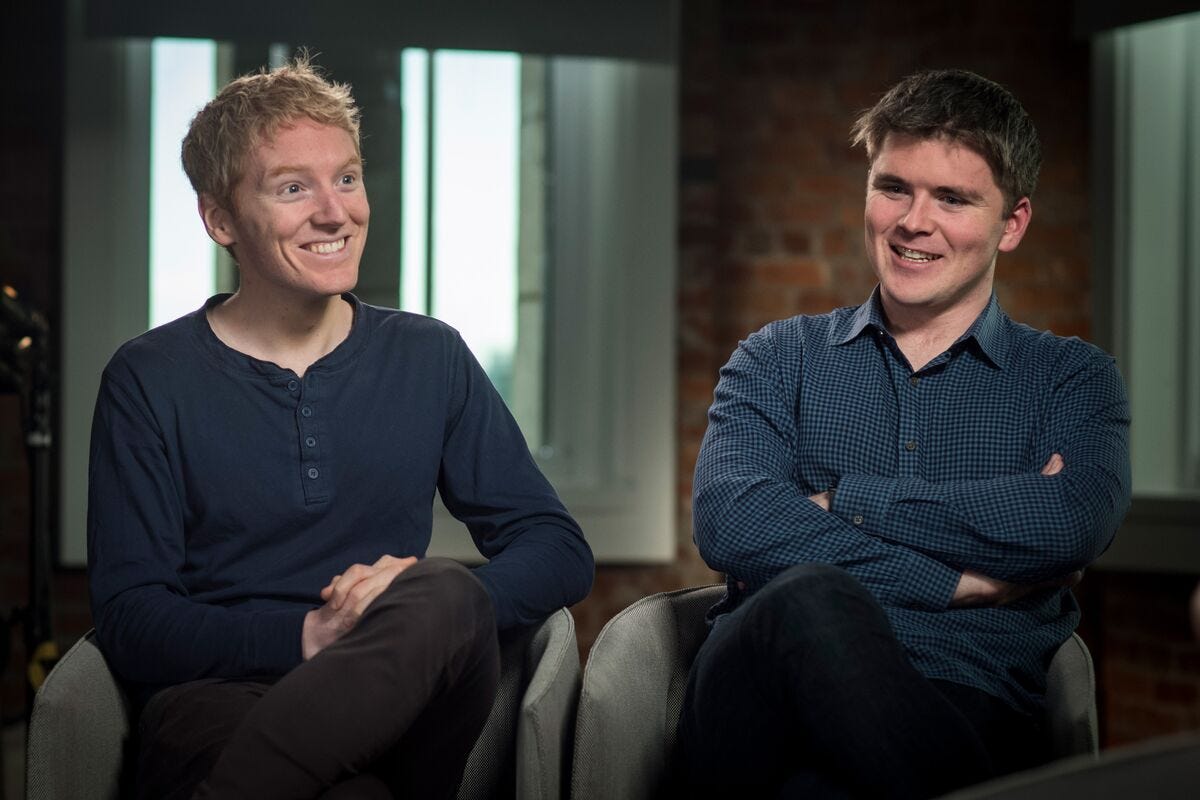
Patrick and John Collison began working on Stripe in the fall of 2009. Their first customer, in January 2010, was Ross Boucher, a friend from their early Y Combinator days. When the brothers came back to the US, they went straight to YC looking for more. The company’s first 20 or so users came from that network: technical founders, building online products, all of whom needed to take money, and who already knew the Collisons.
Then came the part that got a name. To use Stripe, a founder had to add its code to their own website, and a job like that can sit on a to-do list for weeks. Most startup founders who hear “sure, I’ll try your beta” promise to send a link, then wait and hope. The Collisons skipped the link. When someone agreed to try Stripe, they said, “Right then, give me your laptop,” and set it up on the spot. By the time the conversation ended, Stripe was already installed. Y Combinator started calling the move the “Collision installation,” and Paul Graham made the term famous in his 2013 essay “Do Things That Don’t Scale.”
That is the tactic everyone remembers. Behind it was something less glamorous: early on, when someone signed up, a friend at a payments gateway set up the merchant account for that user by hand. The elegant API out front had a person doing paperwork behind it.
Now look at how slowly all of this went. The brothers started working on Stripe in the fall of 2009 and launched publicly in September 2011. After two full years of work, John Collison says Stripe had about 50 users. He remembers that it felt like very little progress. His point is that a good idea and a bad idea can feel the same in the early days, because both feel slow.
He also credits that slowness for what came next. With so few users, the team could spend real time on every one of them.
The Side Project That Found the Customers
Shopify, building the audience first
Rahal went door to door. The Collisons asked for your laptop. Tobias Lütke did neither. His first customers came to him, and the reason goes back to a side project.
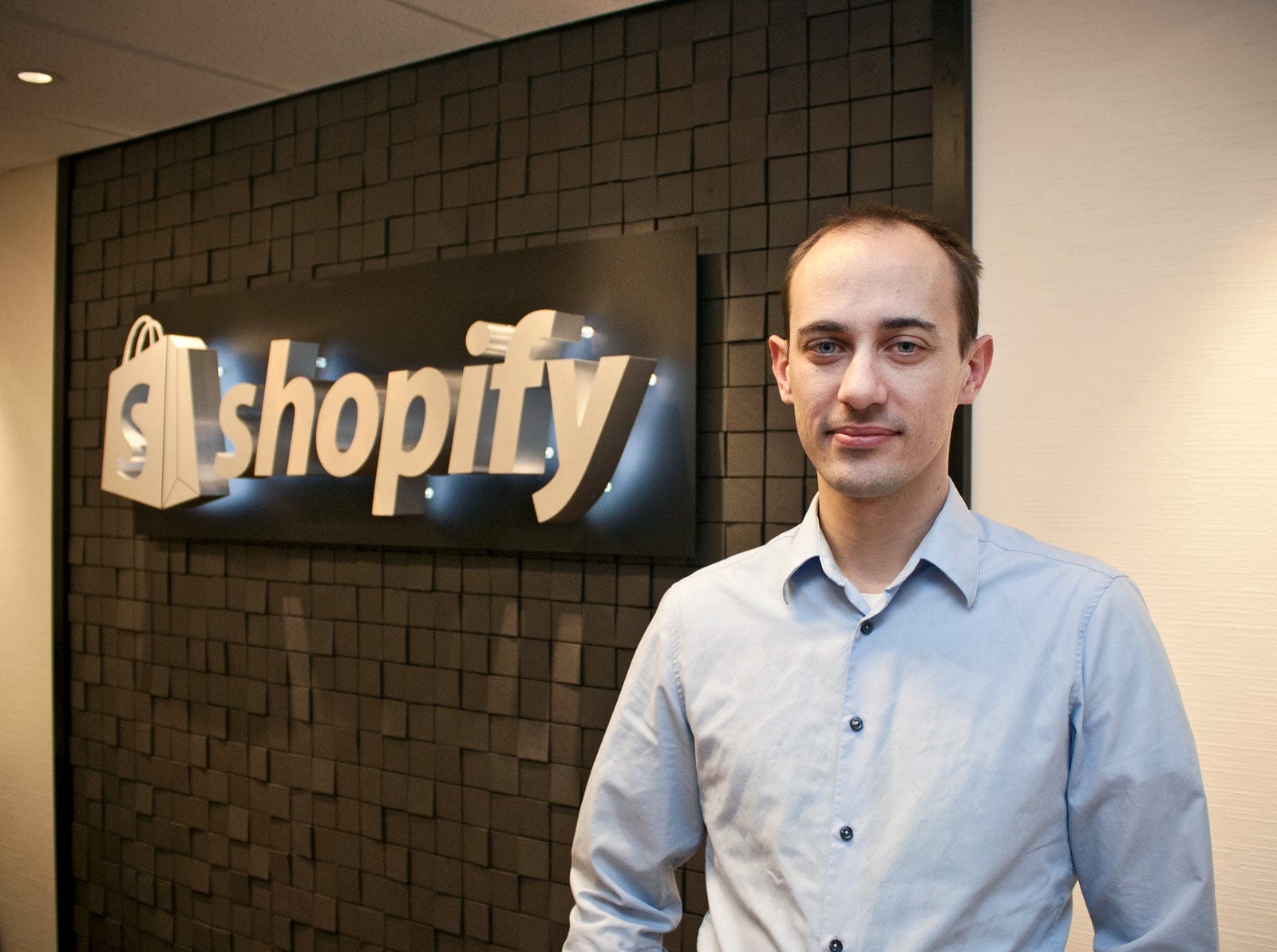
In 2004, Lütke was a German programmer living in Ottawa. His employer had folded, and he was burnt out. He and a friend, Scott Lake, decided to sell snowboards online through a store called Snowdevil. Every piece of store software he tried was too clumsy, so he wrote his own.
Snowdevil opened that November. The first order arrived by email while Lütke was working in a coffee shop, and he later called it one of the most important moments of his life. But the store itself stayed small. Lake later put that first season at about 40 boards.
The software was the valuable part. When winter ended and snowboard sales dropped, the founders decided to turn it into a product that any store could use. That product became Shopify, and Snowdevil was effectively its first customer.
So where did the next customers come from? While building the store, Lütke had also written a free blogging tool called Typo, just for fun. Programmers liked it. By 2005, it had about 10,000 installations, and each one linked back to Lütke’s personal blog. Without trying to market anything, he had built up a large group of readers. He later called it “the biggest SEO scheme of all times.”
When Shopify launched in June 2006, those readers were already there to hear about it. Lütke names that audience as one of the biggest boosts to the launch.
Programmers might seem like the wrong audience for a product built for people who can’t code. Lütke explains why they mattered: when someone wants to open an online store, they ask the technical person in the family. Win over the programmer, and you win the relative asking for advice.
The product still had to be simple enough for that relative. Before launch, the team’s test was whether they could rebuild the Snowdevil store on Shopify in under half an hour. Later, Lütke’s 72-year-old mother-in-law ran a Persian carpet store on Shopify. If a screen confused her, the screen changed.
The company still almost didn’t make it, because the pricing was wrong. Shopify first took a percentage of every sale, so its biggest sellers paid the most, and stores selling almost nothing paid almost nothing. The merchants it wanted most were the ones it was turning away. By one widely repeated account, Shopify was making only about $8,000 a month in 2007 and was close to going under.
Two things turned it around. An angel investor, John Phillips, reached out and put in money. And Shopify switched to a monthly fee with a smaller cut of sales, which made it a far better deal for serious sellers. Lütke sometimes calls that pricing change the product’s true launch.
Revenue passed $1 million in 2008. Shopify went public in 2015, and in 2025 its merchants processed $378 billion in sales. Its first customers came from a blog Lütke never meant as a sales channel.
What Actually Compounds
Lay the three stories side by side, and the models stay different. The pattern underneath them is the same.
They picked a room where a yes was already likely. A CrossFit gym, the YC network, the Ruby on Rails community. The test of a good first room is density: everyone in it has the same problem, and they talk to each other.
They removed the hardest step, whatever it was for their model. For a physical product, that’s shelf space and reordering, so Rahal handed out his phone number. For software, it’s setup, so the Collisons did the setup. For a merchant who can’t code, it’s knowing which software to trust, so Shopify won over the technical friend they’d ask.
They stayed close enough to hear the truth. Rahal’s sampling became his label. Stripe’s handful of users shaped its product. Shopify’s screens had to make sense to a 72-year-old carpet seller.
That last one is what compounds. The customers themselves were almost beside the point. Ten customers won’t move your revenue, and they weren’t meant to. They teach you what your company actually is, and you can’t learn that from a dashboard or buy it later.
It would be dishonest to skip the fine print. The Collisons had already sold a company. Lütke had been programming since he was 12. Rahal’s family was in the food business. Each of them had an advantage getting into the room.
But look at how small the rooms were. Rahal’s was the gym he already went to. Boucher was a friend. Lütke’s was the readers of a blog tied to a side project. None of them waited to feel qualified, and none of them had anything you’d call traction.
So if you’ve been at this for two years and you can still count your customers on your hands, remember the 50 users Stripe launched with. You may be on schedule.
You don’t need a market yet. You need one room and ten people. Figure out which room you’ve already earned your way into. Then go there this week, and do the hard part for them.
Be Bold. Be Real. Be Anomalous.
Follow for more Be Anomalous stories, conversations, and behind-the-scenes.
Website | Instagram | LinkedIn | YouTube | @iamsaimenon
Thanks for reading Be Anomalous! Subscribe for free to receive new posts and support my work.