


Monica Nassif, Mrs. Meyer’s Clean Day, and the book that explains how a woman from Granger, Iowa, built a brand out of what was already in the house
In 1999, a 43-year-old marketing consultant from Minneapolis was in Atlanta on a business trip, still running her own marketing agency back home, when she walked into a big-box home store and found the saddest shelf in America.
It was a worn wooden pallet of household cleaners. Half the bottles had tipped over. Loud colors, oversized triggers, and “70% off” starbursts slapped on everything. In 1999, clean was supposed to smell like bleach and ammonia and look like it had been forgotten in a garage.
Monica Nassif had Aveda shampoo at home. She liked her shampoo. She liked her skincare. So she asked a question nobody in a $30 billion category seemed to be asking: why can’t I love my cleaners?
She started writing the business plan on the plane out of Atlanta.
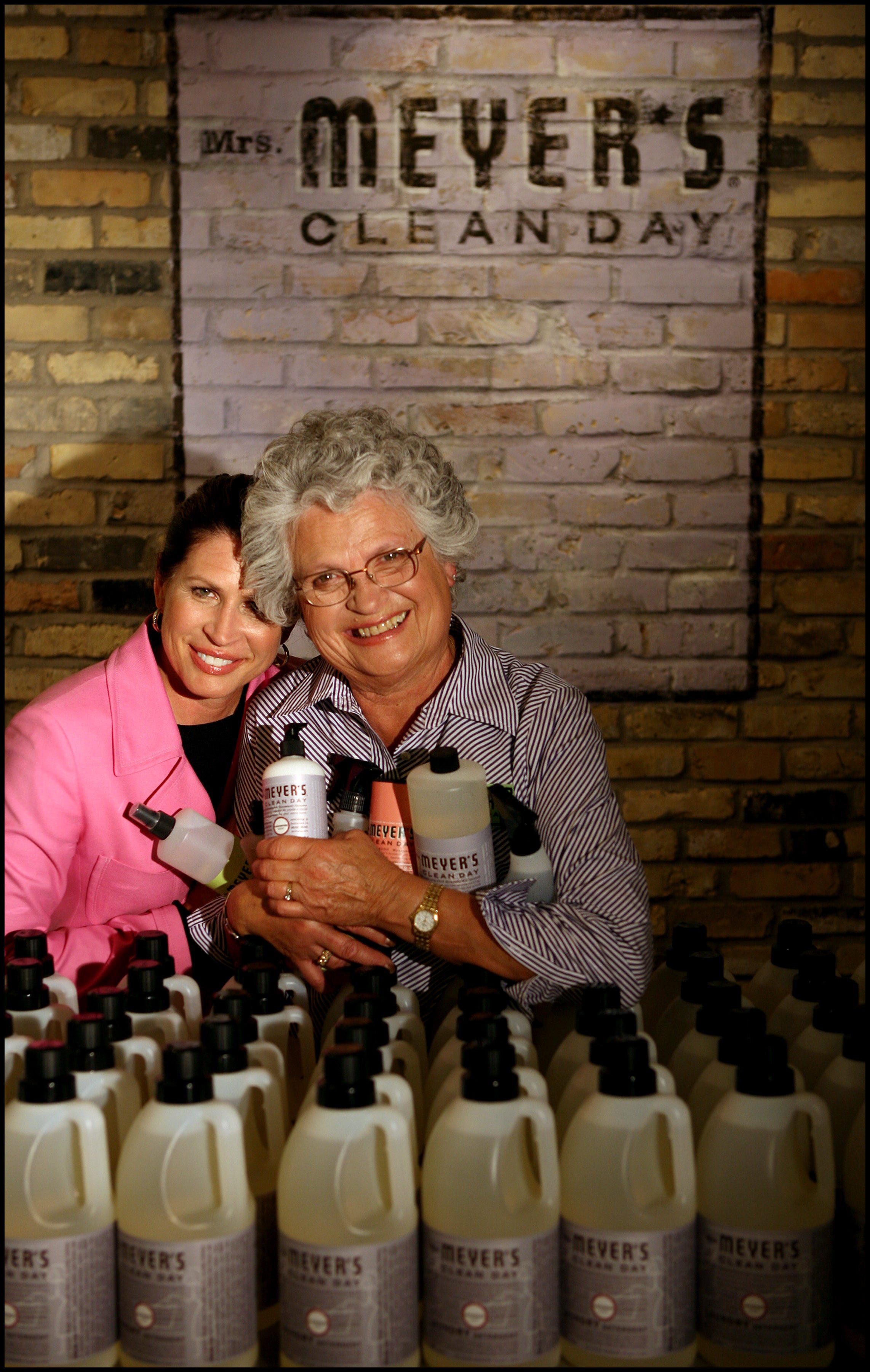
Nine years later, she sold that idea to SC Johnson. The brand it became, Mrs. Meyer’s Clean Day, was in more than 20,000 stores. And the face on the bottle was not a model or a mascot from a branding agency. It was her mother, Thelma Meyer, a nurse who raised nine children in Iowa and who, when her daughter asked to use her name, reportedly answered: “What’s a brand?”
This spring, Nassif told the whole story herself in I Bottled My Mother: The Mrs. Meyer’s Story: Grit, Grime & Growing a Business. It’s part memoir, part business manual, and it’s built around one question that should feel uncomfortably familiar to anyone in the middle of building something: how do you make your way in the world using what you already have?
Let’s go under the hood.
Subscribe to Be Anomalous for a new Under the Hood every week: the founders, the moves, and the unglamorous middle years nobody posts about. Strategy without the fluff.
Part 1: The Kitchen Table Was the First Business School
Monica Meyer was born in 1956 in Granger, Iowa, one of nine children in a household run by Thelma Meyer.
Thelma grew up on a Kansas farm, trained as a nurse, and kept nursing after she married. She had nine kids in roughly ten years. In the book and in interviews since, Nassif describes her mother’s home as a logistics operation. There was a “hub and spoke” system with the sewing machine at the center, and it was organized enough that Nassif jokes her mother was ahead of FedEx and Delta.
The values Nassif says she later put into the bottle came from that house: frugal, hardworking, earnest. You reuse. You repurpose. You take care of what you have.
The Meyer kids worked. Monica walked soybean fields pulling weeds, cleaned a hair salon, and lied about her age at 15 to get a job waitressing at a truck stop. Her boss there taught her to handle unwanted advances with a pot of hot coffee. Her father offered her an electric typewriter if she quit smoking. She took the deal and used it to land a job as a secretary in the emergency room at Mercy Hospital in Des Moines.
She calls these the most instructive jobs of her life. Her parents preached two things: the confidence of a paycheck, and learning to work with people. The ER taught her what actually matters. The truck stop taught her to read a room.
None of this looks like a founder origin story. That’s the point.
Part 2: The Invisible Years
Here’s the part of Nassif’s résumé that rarely makes the highlight reel.
She earned a nursing degree from the University of Iowa in 1979 and worked as a nurse. Then she went back to school for an English degree at the University of Minnesota, finishing in 1983. In 1985, she joined Dayton Hudson, the company that became Target, in communications, writing speeches for its president, Boake Sells.
Sells did something that turned out to matter more than any title. He took her on store walk-throughs and had her critique the displays, the assortments, and the trends. She was a speechwriter being quietly trained to see retail.
Around 1989, she co-founded Kilter Inc., a Minneapolis marketing and design agency, and ran it for about a decade, serving retailers and consumer brands, Target among them. And she grew frustrated. She kept handing clients good ideas and watching them fail to turn those ideas into real businesses.
Add it up. Nurse, speechwriter, publicist, agency owner. By the time she stood in front of that pallet in Atlanta, Nassif had spent roughly twenty years in jobs that had nothing to do with cleaning products and everything to do with what came next:
Nursing gave her a feel for what’s safe to put in a home.
Speechwriting taught her to make a promise in plain language.
Store walks with Sells trained her eye for a shelf.
Ten years of agency work showed her how brands get built, and how they die in execution.
She wasn’t late. She was loading.
Part 3: Cracking the Code (Without Knowing How to Make Soap)
Nassif knew branding. She did not know how to make a liquid that cleans a floor.
So she did the most underrated thing a founder can do: she asked around. Minneapolis happened to be full of people who understood liquid filling, thanks to companies like 3M, Ecolab, and Aveda. A haircut led to a fragrance consultant. The fragrance consultant led to a contract filler that had made hair care for Revlon. Nassif showed up with a PowerPoint and dummy bottles, and the consultant told her she’d cracked the code.
The chemists were harder to win over. Several dismissed the idea outright. Then, over coffee in South Minneapolis, she pitched Pam Helms, a chemist who signed on as a consultant and started experimenting with plant extracts and essential oils. Helms brought a rule that kept the whole venture honest: a cleaner has to actually clean, or customers won’t come back. Pretty bottles get the first purchase. Performance gets the second. (Helms later went on to lead R&D at SC Johnson.)
Then came the money, which Nassif has called the hardest part of the entire journey. Many of the investors she pitched, mostly older men, didn’t get why anyone would pay more for a cleaner. Local businessman Mike Fiterman was one of the skeptics who passed. She raised $1.4 million from angel investors anyway. Years later, Fiterman asked her to join his board.
The lesson hiding in this section: Nassif didn’t have the technical skill, the industry network, or the capital. She had a clear picture of the product and the nerve to keep asking strangers for help. In the book, she calls this making your own luck.
Part 4: Knock Yourself Off Before Someone Else Does
The first brand wasn’t Mrs. Meyer’s. It was Caldrea, named for her daughters, Calla and Aundrea. It was high-end aromatherapy for the home, with scents like ylang-ylang and patchouli, priced for boutiques. It first shipped to stores in Dallas and grew into roughly 4,000 specialty gift shops, home stores, and upscale grocers, Restoration Hardware among them.
By most measures, Caldrea was working. Nassif was uneasy anyway.
She’d done the math. About 80% of household cleaning products are sold in the mass market, and Caldrea wasn’t anywhere near it. A niche premium idea that’s obviously working is an invitation. Someone, she figured, was going to knock her off.
Then her mother weighed in. Thelma loved Caldrea and couldn’t justify the price. Could Monica make something regular families could afford?
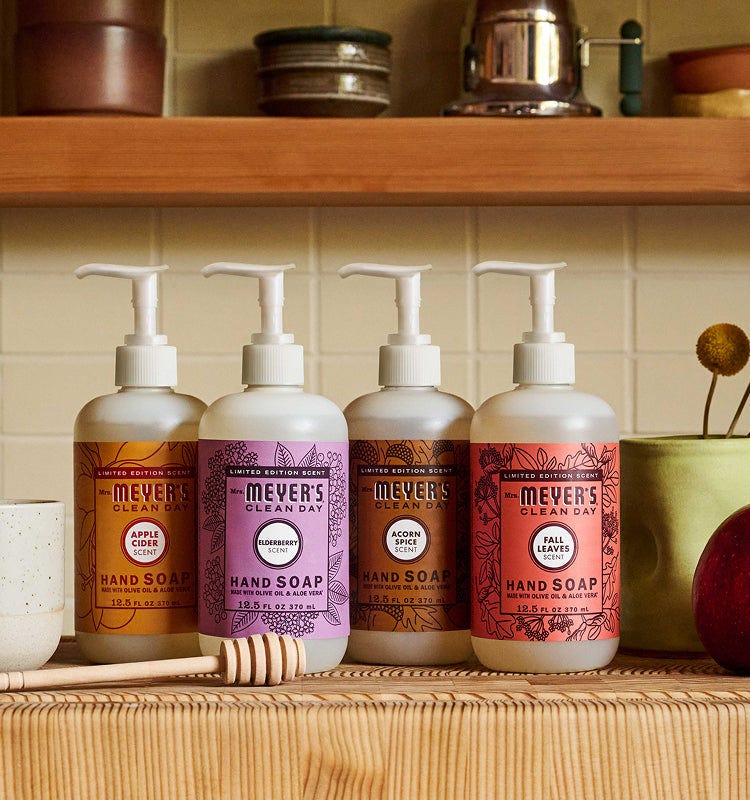
So Nassif did what most founders can’t stomach. She built the competitor to her own brand. Mrs. Meyer’s Clean Day launched in the early 2000s at a lower price, with friendlier scents like lemon verbena, basil, and lavender. It had a Midwestern sensibility and a real woman’s name on the label. It was a deliberate knockoff of Caldrea, made by Caldrea.
She credits a former boss for the principle she lived by: cut the branch you’re sitting on so you’re forced to reach for the next one. Business strategists call this cannibalizing your own advantage. Nassif just saw it as getting there first.
And the name did something no agency could have bought. Mrs. Meyer wasn’t a character. She was a real nurse and mother of nine from Iowa, and by her late eighties, Thelma was traveling to stores as the brand’s ambassador. The story was true, so it held up.
Part 5: The Stumbly-Bumbly Middle
Nassif has described the early Mrs. Meyer’s years as a “stumbly bumbly start” that later turned into a rocket ship. The middle is where most of the book’s best lessons live.
She said no to money she needed. Some stores wanted to carry only a few products. Nassif turned those orders down even when cash was tight. She wanted the full line on the shelf together, the way a personal care brand gets displayed. The bottles were meant to be what she called jewelry for the counter, pretty enough that you’d never hide them under the sink.
She ran three businesses at once. Alongside Caldrea and Mrs. Meyer’s, the company made private-label soaps and sprays for Williams-Sonoma, Crate & Barrel, and London’s Harvey Nichols. The private-label work paid the bills and validated the concept, and Nassif negotiated to get the Mrs. Meyer’s name onto the Williams-Sonoma bottles.
She bombed on TV. She’s talked openly about a disastrous QVC appearance. It was a public flop she lived through and moved past.
She fired herself from Target. This is the move most founders would never make. Mrs. Meyer’s got into Target too early. It wasn’t yet in the key markets where it was already selling at Whole Foods, and it wasn’t performing. Rather than wait to be dropped, Nassif pulled the brand out herself. Her rule: kick yourself out before someone kicks you out. She rebuilt through specialty retail, went back to Target about two years later on stronger footing, and used that momentum to get into higher-end grocery chains.
She built operations before she needed them. Nassif insists the back end (finance, IT, warehousing) has to keep pace with sales, because big retailers fine you for every late or wrong shipment. Every morning the whole team got the same update: sales against goal, and whether orders were shipping within 48 hours. When a truckload of detergent froze on Colorado’s Vail Pass, or a crate of products went missing before a trade show, she was there until midnight rebuilding the booth with everyone else.
She was working 14-hour days. She kept a picture in her head of an end-cap filled with her products and told herself, on the bad days, that it could happen.
By 2007, Mrs. Meyer’s was reportedly doing more than $20 million in revenue, profitably.
Part 6: Knowing When to Let Go
In 2008, with the business thriving and Walmart talks underway, Nassif sold Caldrea and Mrs. Meyer’s to SC Johnson.
Private equity firms had come calling. Her test for them was simple: what can you do for this brand that we can’t do ourselves? None gave her a convincing answer. SC Johnson could scale the brand globally, and she believed it would be a good steward. She also read the moment: organic food and personal care brands were being bought up by strategic acquirers, and she chose to sell while conditions were good.
She calls the sale bittersweet. Nearly two decades later, she still straightens the bottles when she walks past them at Target.
What came after is just as instructive. She tried to retire and, in her words, failed miserably. In 2011, she launched Sophia Graydon, a luxury sleepwear line for older women. It got into Vogue, but she shut it down when it missed the sales target she’d set. In conversation with Guy Raz, she drew the distinction plainly: she was obsessed with Mrs. Meyer’s and wasn’t obsessed with the second business, and that obsession is what makes the difference.
She has said she launched four startups: two succeeded and two flopped. She went on to lead the board of the Walker Art Center, sit on consumer brand boards, invest, take a screenwriting class during COVID, and write a book.
Part 7: Inside the Book — I Bottled My Mother
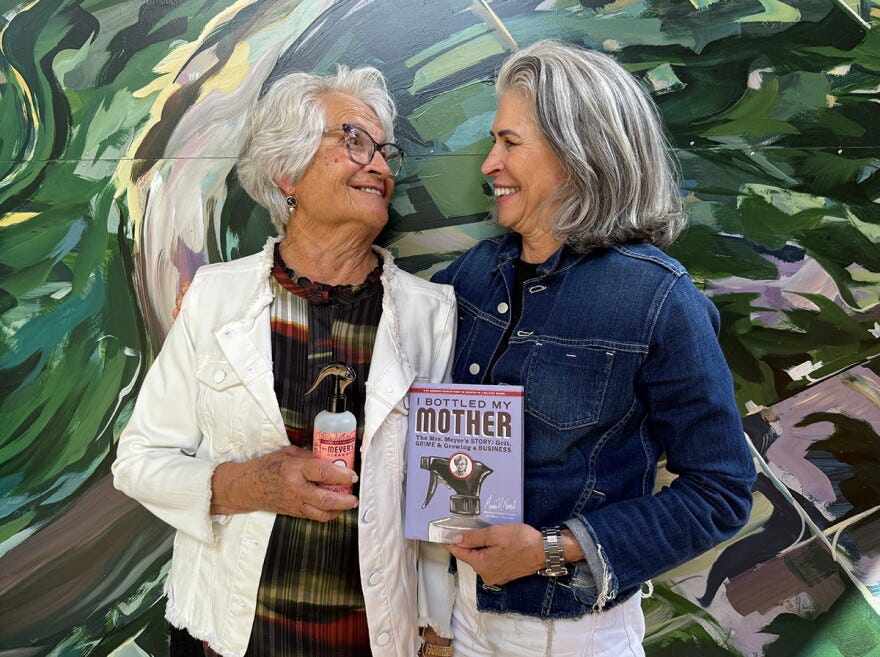
I Bottled My Mother: The Mrs. Meyer’s Story: Grit, Grime & Growing a Business (Ideapress Publishing, distributed by Simon & Schuster) came out in spring 2026. It runs about 216 pages, and Rohit Bhargava’s team worked with Nassif on it for a year.
The book braids two stories together.
The memoir half is about Thelma: the Kansas farm girl turned nurse turned mother of nine, and the Iowa house where hard work wasn’t a virtue you talked about, just the air you breathed. Nassif traces how a childhood of soybean fields, truck stops, and “the confidence of a paycheck” became the operating system for her company. This is the book’s emotional engine, and reviewers agree it’s the strongest part.
The manual half is Nassif’s playbook, written in short, plain chapters for people who want to start something. Pulling together the book’s framing and her interviews around it, the core lessons are:
Train your eye in person. Walk the stores. Study the shelf: assortment, price points, placement. Study the aspirational brands your customer already loves, even in other categories. Caldrea borrowed from home décor, skincare, and fashion.
Know who you’re displacing. Retailers won’t invent space for you. You need to know which product you’re replacing, and beat it on margin and sales.
Disrupt, don’t tweak. Small improvements go unnoticed. Stand for something, make a clear promise, and keep it.
Start small to learn to ship. Prove reorders with smaller retailers and fix your operations before a giant retailer fines you for mistakes.
Treat “no” as the start of a conversation.
Cut the branch you’re sitting on. Be willing to cannibalize your own success.
Fix problems head-on, then move on. Keep making decisions. A former boss told her he made five decisions a day, two of them bad, and kept going.
Look through the windshield, not the rearview mirror.
And there’s one more chapter that isn’t in the book. Thelma, now in her nineties, went on the book tour. By most accounts, she’s been out-promoting her daughter.
Your Move
If you’re 35, 43, or 55 and feel like you took the long way, look harder at the long way.
The job that felt like a detour, the side skill you never put on LinkedIn, the way you were raised, the thing your family always just did: that might be the bottle.
You’re not behind. The invisible years count. And your circumstances, whether that’s a small town, no capital, or no clue how to make the thing, don’t set your ceiling. Monica Nassif didn’t know how to make soap. She knew what she was looking at.
So what’s already in your house?
Be Bold. Be Real. Be Anomalous.
Follow for more Be Anomalous stories, conversations, and behind-the-scenes.
Website | Instagram | LinkedIn | YouTube | @iamsaimenon