


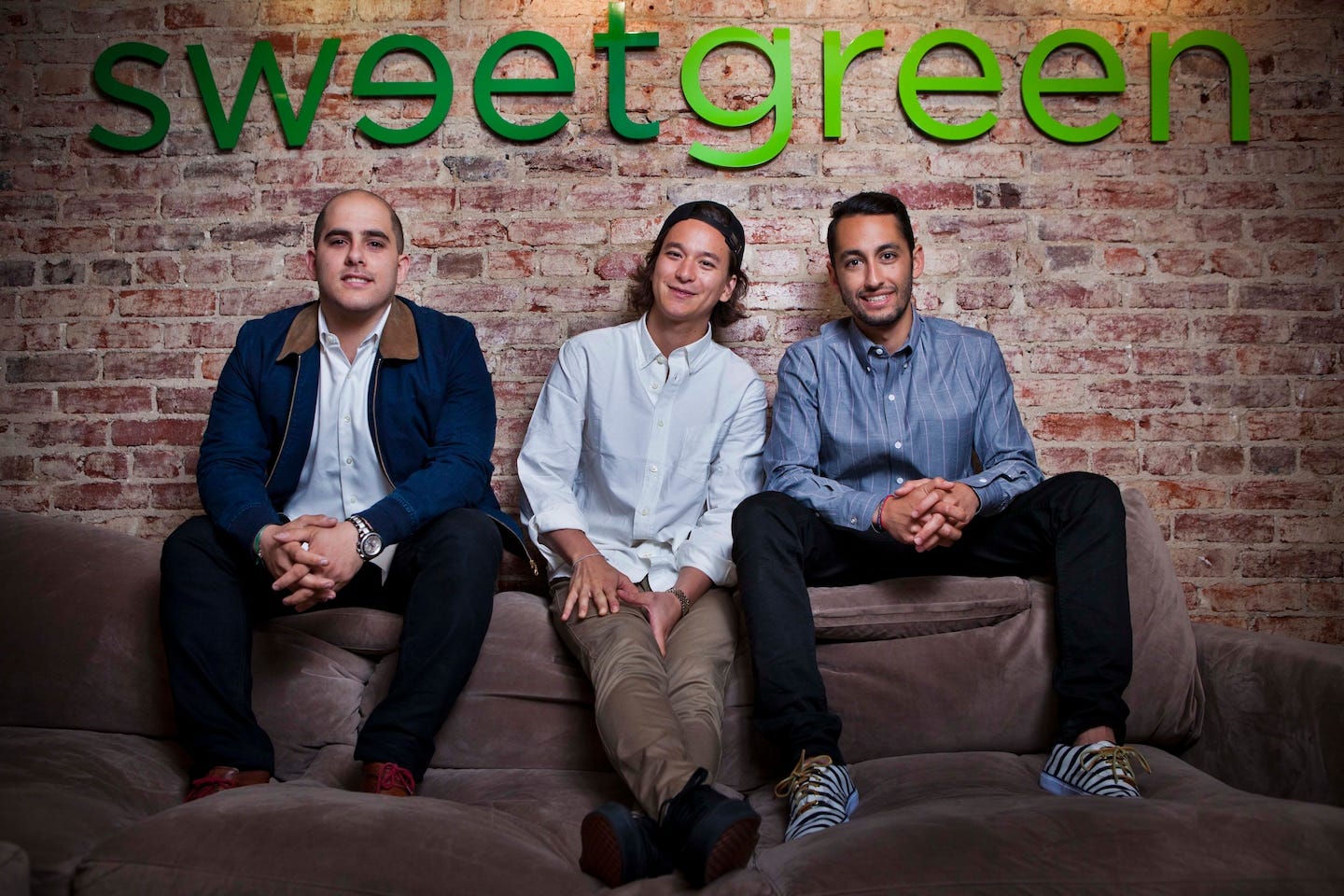
How three college students built a billion-dollar brand—and why it’s struggling to survive
The story begins in 2006 with three Georgetown University students who were tired of eating terrible food. Jonathan Neman, Nicolas Jammet, and Nathaniel Ru looked around their campus and saw the same frustrating trade-off that millions of young Americans faced daily: you could eat fast and cheap, or you could eat healthy and expensive. There was nothing in between.
Three months after graduation, they opened a 560-square-foot salad shop in a Georgetown alley. They called it Sweetgreen.
Nearly two decades later, that tiny shop has become a cautionary tale about modern entrepreneurship. Sweetgreen is now a publicly traded company with 266 locations, over $677 million in annual revenue, and a brand so recognizable that Kendrick Lamar once had a signature salad. It’s also losing roughly $90 million per year, its stock has crashed over 80% from its highs, and same-store sales are falling at an accelerating rate.
The central paradox that every entrepreneur should study: How does a company with such a beloved brand, such loyal customers, and such strong revenue growth struggle to sell $16 salads profitably?
The answer reveals everything wrong with how we build companies in the age of venture capital, growth-at-all-costs, and unicorn fever.
Part I: The Magic Years
In the beginning, Sweetgreen did almost everything right.
The founders started with $375,000 raised from 50 investors—mostly friends, family, and a small business development center. By today’s standards, it was nothing. But it was enough. That first Georgetown location became profitable within months, validating the core insight: people would pay a premium for fresh, healthy, locally-sourced food if you made it convenient and approachable.
What made early Sweetgreen special wasn’t just the food. It was the authenticity of the mission. While other chains talked vaguely about “fresh ingredients,” Sweetgreen displayed the names of their local farmers on boards in every store. They rotated their menu five times per year based on what was actually in season. They refused to use seed oils when every competitor did. They meant it when they said they wanted to “connect people to real food.”
This authenticity attracted a fiercely loyal customer base. Sweetgreen’s Net Promoter Score hit 78 exceptional for any restaurant, let alone a fast-casual. Customers weren’t just buying salads; they were buying into a lifestyle, a set of values, a community.
The founders understood instinctively that their real competition wasn’t other salad chains. It was the fundamental disconnection between people and their food. So they invested in culture-building rather than traditional advertising. They collaborated with celebrity chefs like David Chang and Nancy Silverton. When Kendrick Lamar released his “Beets Don’t Kale My Vibe” salad, it generated over 100 articles and massive cultural buzz.
They were also early adopters of digital ordering, launching a mobile app in 2015 when many restaurant chains were still figuring out their websites. They had built nearly 2 million active app users—a direct relationship with customers that most restaurant chains could only dream about.
By 2018, Sweetgreen had achieved unicorn status with a valuation exceeding $1.6 billion. Three kids who started a salad shop in an alley were now running one of the hottest companies in America.
Everything seemed to be working.
Except for one small problem: the actual business.
Part II: When More Money Creates More Problems
Between 2013 and 2019, Sweetgreen raised over $515 million in venture capital. Investors included Revolution Growth (Steve Case), T. Rowe Price, Fidelity, and other heavyweight firms. Each round valued the company higher than the last, creating a powerful narrative: Sweetgreen wasn’t just a restaurant chain; it was a movement.
But every dollar raised came with strings attached. More capital meant more investors, more board seats, more pressure to justify ever-increasing valuations. And the only way to justify a billion-dollar valuation for a salad chain was aggressive growth.
So Sweetgreen grew. They opened 35 new locations in 2023 alone. They expanded into new markets. They experimented with new formats. They invested heavily in technology, acquiring a robotics startup, Spyce, to build automated salad-making systems. They launched French fries (then discontinued them less than a year later). They overhauled their loyalty program. They talked about reaching 1,000 locations.
They needed to become the next Chipotle, the next Starbucks, the dominant player in healthy fast-casual dining.
But here’s what the spreadsheets and pitch decks missed: the economics of selling $16 salads at scale are brutally difficult.
Start with the cost structure. Sweetgreen’s commitment to local, organic, and sustainable sourcing meant ingredient costs were significantly higher than those of competitors. Real estate costs were high because Sweetgreen targeted prime urban locations with high foot traffic. Seasonal menu rotations meant supply chain complexity that added overhead.
By the time you factored in corporate costs, technology investments, and expansion expenses, the math simply didn’t work. Restaurant-level margins might look decent—17.5% in 2024—but after corporate overhead, the company was losing money on every salad sold. Literally losing approximately $2.26 per $16 salad based on their 2024 financials.
This is the dirty secret of venture-backed retail: you can mask bad unit economics with growth. If revenue is climbing 30-40% per year, investors forgive the losses because they believe you’ll “grow into profitability.”
The assumption is that scale will drive efficiency, that technology will reduce costs, and that market dominance will allow pricing power.
The warning signs were there. In earnings calls, management admitted that only one-third of Sweetgreen locations were consistently operating at or above standard. Think about that: two-thirds of stores were underperforming baseline expectations for food quality, service speed, and operational consistency. Yet the company kept opening new stores, kept expanding into new markets, kept chasing growth.
Part III: The Public Market Reality Check
In November 2021, Sweetgreen went public. But going public when you’re unprofitable is extraordinarily risky. Private investors can be patient; public market investors demand results every 90 days.
By the third quarter of 2025, same-store sales had collapsed by 9.5%, and traffic fell 11.7%. The company lost $36 million in a single quarter. The stock, which had traded above $40 per share, plummeted to around $6.
What went wrong? Value perception. At $16-17 for a salad, Sweetgreen was roughly 40% more expensive than Chipotle and 25% more expensive than Cava. When inflation squeezed household budgets, that $16 salad went from staple to indulgence. Sweetgreen’s core demographic—urban professionals aged 25-35—pulled back first and hardest. When forced to choose between values and budget, most chose budget.
Management tried to respond with larger portions and discount promotions, but repositioning from premium to value is nearly impossible without damaging your brand. Meanwhile, operational missteps multiplied: the French fries launch and quick discontinuation, a loyalty program overhaul that alienated high-frequency customers, staff cuts, and the sale of Spyce—the robotics company they’d acquired to automate salad-making—for $186 million.
Part IV: Three Possible Futures
So what happens to Sweetgreen?
Scenario 1: The Turnaround (15% probability)
Sweetgreen figures it out. They fix value perception with sustainable pricing, achieve operational excellence across all stores, reach profitability with their existing footprint, and prove the model works. Same-store sales return to growth by late 2026, margins expand, and the stock recovers to $15-20.
This requires discipline to slow growth, wisdom to cut costs without cutting quality, and time for changes to take effect. It’s possible but unlikely.
Scenario 2: Muddle Through (60% probability)
Sales stabilize but don’t grow meaningfully. The company continues opening 15-20 stores annually, burns through cash while promising profitability “next year,” and eventually needs to raise dilutive capital. They settle into a smaller, regional footprint focused on their strongest markets. The stock remains depressed at $5-10. The company survives but doesn’t thrive.
This is the most likely outcome. They’re good enough to avoid collapse but not good enough to break through.
Scenario 3: Acquisition or Pivot (25% probability)
Sweetgreen is acquired by Starbucks (as a healthy food platform), Chipotle (as a premium complement), private equity (to restructure), or a food tech platform like Wonder. Alternatively, they dramatically reduce their footprint to 50-75 profitable stores and pivot to high-margin channels like catering, meal kits, and CPG products.
Sometimes survival means getting smaller, not bigger. Not every company needs to be a unicorn.
A Final Thought
If you’re an entrepreneur reading this, ask yourself: Are you building a business or are you building a brand?
Because here’s the truth—you need both. A great brand with terrible economics is a charity. Great economics with no brand is a commodity. The magic happens when you build something people love AND something that makes money sustainably.
Sweetgreen got halfway there. They built something people love. They created a movement around real food, sustainability, and community. They proved that fast-casual dining could be healthy, delicious, and culturally relevant.
But they forgot the most important part: the business has to work.
Fix the economics first. Build the brand second. Scale third.
That’s the lesson Sweetgreen is learning the hard way.
Because in the end, the graveyard of startups is filled with beautiful brands that couldn’t make the math work.
All financial data from public sources, including Sweetgreen earnings calls, SEC filings, and news reports through January 2026.