


There’s a version of this story that gets told a lot, and it goes something like this: two scrappy founders with a great idea, a viral TikTok moment, the right investor, and boom, a billion-dollar exit. Clean. Inspirational. Mostly useless.
The real story of what Poppi and Grüns actually pulled off is more interesting, more replicable, and more instructive, but only if you’re willing to look past the headline numbers and into the mechanics underneath.
So let’s go under the hood.
Two Brands, One Insight
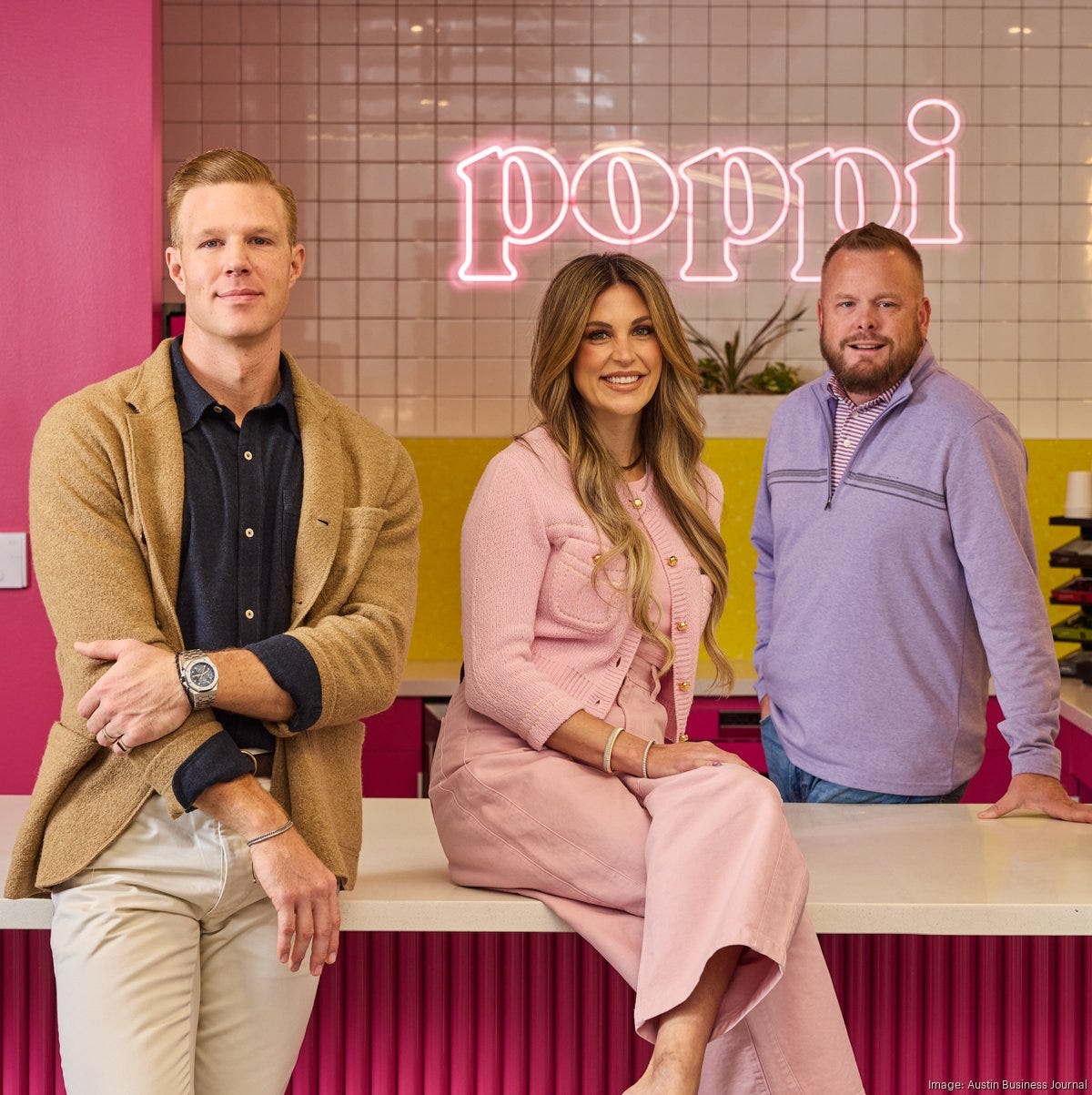
Poppi started in a Texas kitchen. Allison Ellsworth was dealing with chronic health issues and discovered that apple cider vinegar was helping her gut. She started mixing it with fruit juice to make it drinkable, then sellable, then pitchable. In 2018, she and her husband, Stephen, walked onto Shark Tank and landed Rohan Oza, the man who helped build Vitaminwater and Smartwater, as their investor and brand architect. By May 2025, PepsiCo had closed a $1.95 billion acquisition.
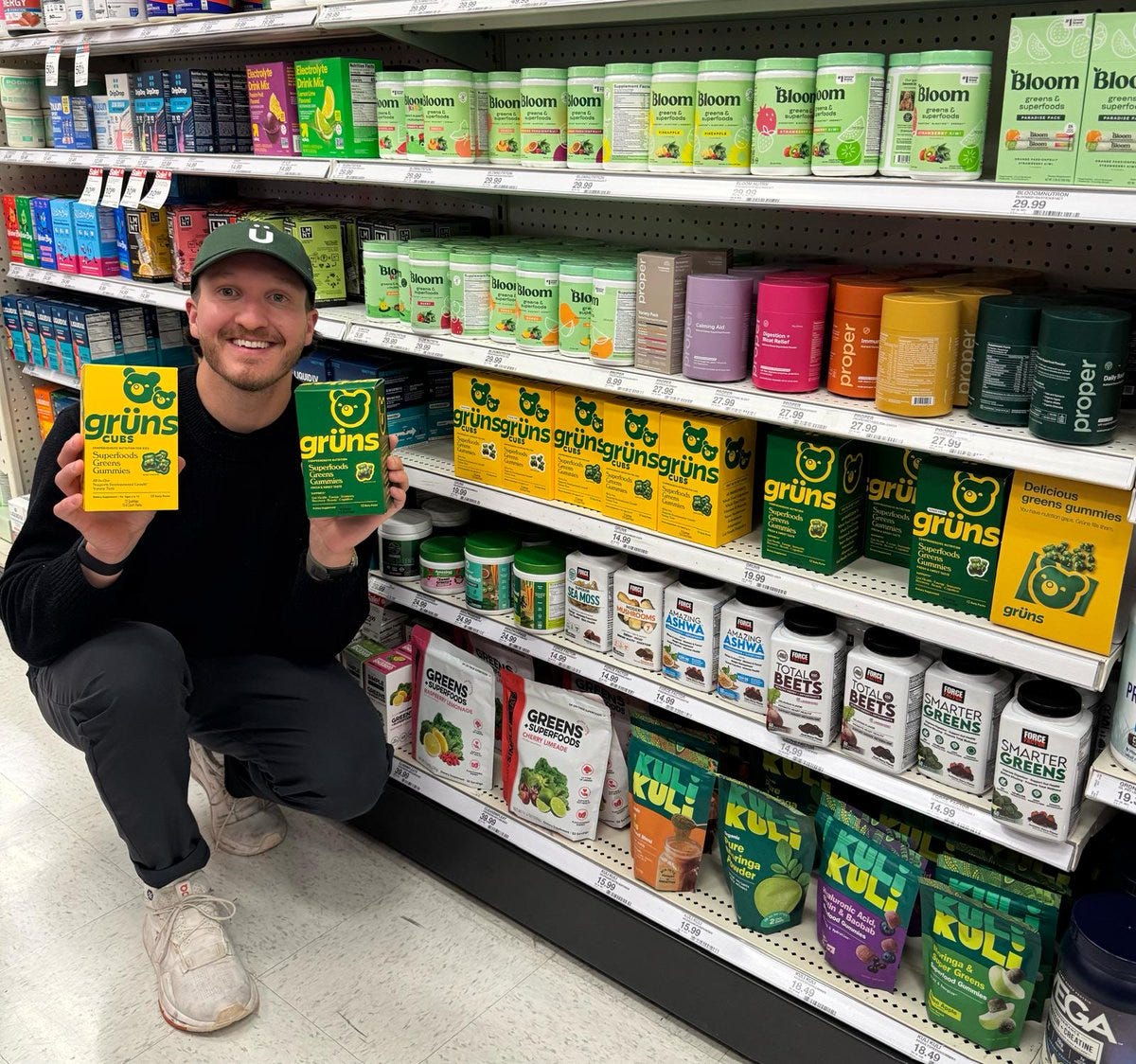
Grüns started at Stanford. Chad Janis, a 30-year-old graduate student with a toddler, was drinking powdered greens one morning and had a simple, almost obvious thought: there is no way I’m keeping this habit past 30 days. The powder was chalky. The cleanup was annoying. The ritual felt like punishment. So he asked a different question than most supplement founders ask. Not “how do I make a better greens powder?” but “how do I make this habit actually stick?” The answer was a gummy bear. Packed with 60 ingredients. Launched in August 2023. Acquired by Unilever for $1.2 billion less than three years later.
Different categories. Different founders. Different investors. No shared institutional backers to speak of. And yet both companies ran what is essentially the same playbook because they both diagnosed the same root problem hiding inside two very different product categories.
The problem wasn’t the product. It was the habit.
The Habit Trap Most Founders Walk Into
Here’s the conventional wisdom in consumer wellness: make something that works, prove the science, get distribution, win.
It sounds right. It’s mostly wrong or at least incomplete.
The brands that get acquired for ten figures aren’t the ones with the best formulas. They’re the ones with the best retention. And retention isn’t a marketing metric. It’s a product metric. It’s the answer to a brutally simple question: Will someone actually do this again tomorrow?
Poppi understood that people weren’t quitting soda because they wanted to. They were quitting because the alternatives, flat water, bitter kombucha, and sad sparkling water didn’t scratch the same itch. The ritual of cracking open a cold can, the sweetness, the carbonation, the moment of it, that’s what people were grieving. Poppi gave it back to them with a functional wrapper.
Grüns understood that the greens supplement category was full of products that worked on paper and failed in the bathroom cabinet. People bought them with good intentions and abandoned them within weeks. The category’s dirty secret was that its unit economics depended on repurchase, and its repurchase rates were terrible because nobody actually enjoys drinking green sludge every morning. Janis didn’t make a better sludge. He eliminated the sludge.
By the time Unilever came calling, Grüns had 95% of its customers using the product four to six times a week. That number is almost offensively good for a supplement brand. It’s the kind of retention that makes acquirers do math in their heads and start clearing calendar time.
The lesson here isn’t to make a gummy or a soda. The lesson is to ask: what is the real reason people quit this category, and what would it look like to solve that instead of ignoring it?
Brand Is Not a Vibe. It’s a Strategy.
Both companies invested heavily in brand, and both got criticized for it at various points: too flashy, too influencer-heavy, not enough substance. Both got acquired for over a billion dollars, so let’s set that criticism aside and understand what they were actually doing.
Rohan Oza, CAVU’s co-founder and Poppi’s first real backer, has a theory about brand that he’s applied across Vitaminwater, Smartwater, BODYARMOR, and now Poppi. The theory is simple: in a commodity category, the brand is the moat. The liquid inside a can is fungible. The feeling of belonging to a brand is not.
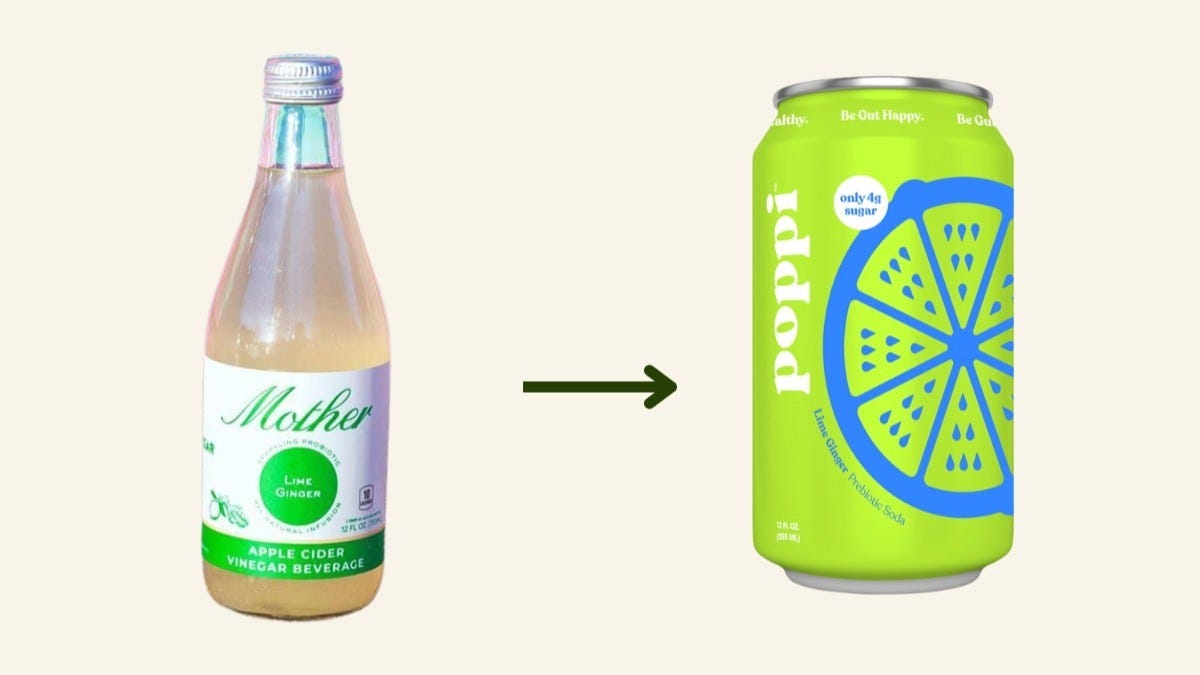
Poppi’s packaging, the bright, almost absurdly cheerful cans with their chunky flavor names, wasn’t just pretty. It was a signal. It said: This is not medicine. This is not a compromise. This is what fun looks like now. They put it on the shelves next to Coca-Cola and made Coca-Cola look tired by comparison.
Grüns did the same thing with a category that looked even worse. Supplement branding has historically been a war of clinical seriousness, lots of green gradients, molecular diagrams, and bold claims about bioavailability. Grüns launched with gummy bears and called their kids’ line “Cubs.” It was disarming by design. It told potential customers that this brand wasn’t going to lecture them about their health. It was going to make health feel like a treat.
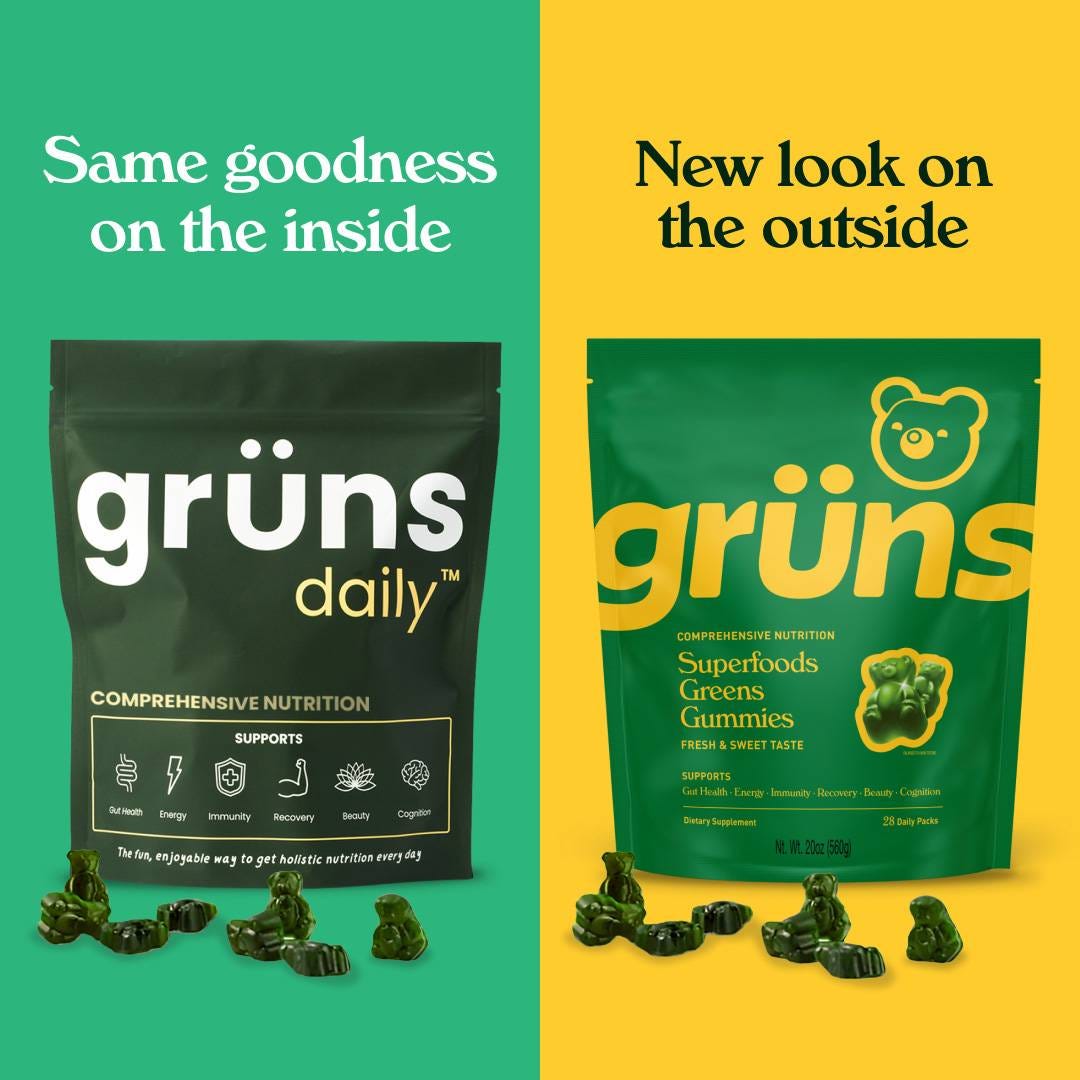
What both brands understood and what most operators miss is that brand is not about aesthetics. It’s about reducing the psychological friction of purchase and repurchase. When a brand feels culturally alive and personally relevant, people don’t just buy it. They talk about it. They post it. They give it to their friends. That word-of-mouth engine is what makes a $40 million raise go as far as it does.
Speaking of which.
The Celebrity Investor Strategy, Decoded
Both companies brought in celebrity investors, and it’s tempting to read that as vanity founders wanting famous friends on their cap table. That’s not what was happening.
Poppi brought in Russell Westbrook, The Chainsmokers, Kygo, Halsey, Ellie Goulding, and a roster of top-tier social media personalities. Grüns brought in Joe Burrow, Shaun White, and Anna Kendrick, among others.
Look at who these people are, and the dynamic becomes clear. These aren’t passive check-writers. They’re distribution channels with personal brands. When Halsey posts about Poppi, she’s not doing an ad; she’s vouching. Her audience has a relationship with her, not with the brand. The first time they see Poppi is through someone they trust, which is worth more than any amount of targeted advertising.
What both companies figured out is that the cost of celebrity equity is often far lower than the cost of the media impressions that the celebrity generates. You’re not paying for endorsement. You’re paying for authentic integration into a cultural conversation you couldn’t buy your way into otherwise.
This is replicable at a smaller scale than most founders think. You don’t need Joe Burrow. You need whoever commands trust and attention in the specific community you’re trying to enter. A mid-tier food blogger with a genuinely loyal audience of 80,000 people in your target demographic is often more valuable than a macro-influencer with 2 million passive followers. The principle is the same: find people whose endorsement means something, and make them part of the story.
The TikTok Moment Is a Symptom, Not the Strategy
Every piece of Poppi coverage mentions the viral TikTok. Allison Ellsworth posted an organic video early in the brand’s life that pulled 26 million views and sent their Amazon ranking through the roof. It’s a great story. It’s also not the reason Poppi sold for $1.95 billion.
The TikTok worked because the brand was already ready. The packaging photographed well. The founder was authentic and compelling on camera. The product had a story, gut health, apple cider vinegar, and a woman who made something in her kitchen to fix her own health problems that people could grasp and share in thirty seconds. The virality was downstream of a dozen other decisions that had nothing to do with TikTok.
This matters because a lot of founders absorb the wrong lesson from these stories. They think: I need to go viral. What they should be thinking is: if I went viral tomorrow, would my brand hold up? Would the story be shareable? Would someone watching a thirty-second video understand immediately what this is and why it matters?
Grüns never had a single viral moment on the scale of Poppi’s early TikTok. What they had was a product so visually distinctive, gummy bears in a supplement aisle, that every piece of content naturally invited curiosity. The format itself did the work. Someone seeing a bag of Grüns for the first time had an immediate question: wait, those are vitamins? That question is the beginning of a conversation.
Build something that generates questions. The algorithm will take care of the rest.
Retail as Signal, Not Just Revenue
Neither brand treated retail expansion as a sales play. They treated it as a credibility play.
This is a crucial distinction. When Grüns launched in Target and immediately became the number-one supplement brand on their shelves, prompting the retailer to accelerate their timeline for stocking additional SKUs, it wasn’t just driving revenue. It was creating a data point that investors and eventual acquirers could point to. Shelf velocity at a major retailer is one of the most legible metrics in the consumer space. It tells a strategic buyer: real people, not just online loyalists, are choosing this over everything else on offer.
Poppi used the same logic. Every new retail door wasn’t just a sales channel; it was evidence of mainstream appeal. By the time PepsiCo was doing due diligence, Poppi was in over 30,000 retail locations. That’s not a DTC brand playing at brick-and-mortar. That’s a brand that has proven it can win in the most competitive shelf space in the world.
The lesson for earlier-stage operators: treat your first retail partnerships like auditions, not opportunities. Get into fewer doors and win big in each one before expanding. A category captain story at one retailer is worth more than thin distribution across ten.
The Number That Ties It Together
Both brands crossed $300 million in annualized revenue before their exits. That’s not a coincidence. That’s a threshold.
At that scale, the unit economics are proven. The retention data is real. The retail relationships are established. The management team has been tested. An acquirer paying $1 billion or more needs to be able to model a path to returning that investment, and $300 million in ARR is the kind of foundation that makes that modeling believable.
Below that threshold, you’re asking an acquirer to take a bet on your trajectory. Above it, you’re showing them a business. The difference in valuation multiple between those two conversations is enormous.
This is the unsexy truth underneath both of these glamorous exits: they were built on operational excellence. Extraordinary retention. Real unit economics. Supply chains that could actually support national retail. Grüns founder Chad Janis reportedly talked to 20 co-manufacturers before finding one capable of producing a dense, multi-ingredient gummy at scale. That is not a fun process. It is also what separates a brand that exists for $1.2 billion from one that exists for $40 million or doesn’t exist at all.
What You Should Actually Take Away
Strip away the TikToks, the celebrity investors, the colorful packaging, and the billion-dollar headlines, and what Poppi and Grüns actually did is remarkably teachable.
They each found a category where the real consumer problem wasn’t being solved, not the stated problem (I want a healthy drink, I want better nutrition), but the behavioral one (I can’t make this a real habit). They built products that made the habit frictionless and genuinely enjoyable. They wrapped those products in brands that gave people a way to signal something about themselves. They brought in partners, investors, celebrities, and retailers who added more than capital. They scaled operations seriously enough to be credible at the moment a major acquirer needed exactly what they had.
It requires being honest about what problem you’re actually solving, and then being relentless about solving it better than anyone else.
The billion dollars is the outcome. The habit is the product.
Everything else is just packaging.
New article every Tuesday.
Be Bold. Be Real. Be Anomalous.
Follow for more Be Anomalous stories, conversations, and behind-the-scenes.
Website | Instagram | LinkedIn | YouTube | @iamsaimenon