


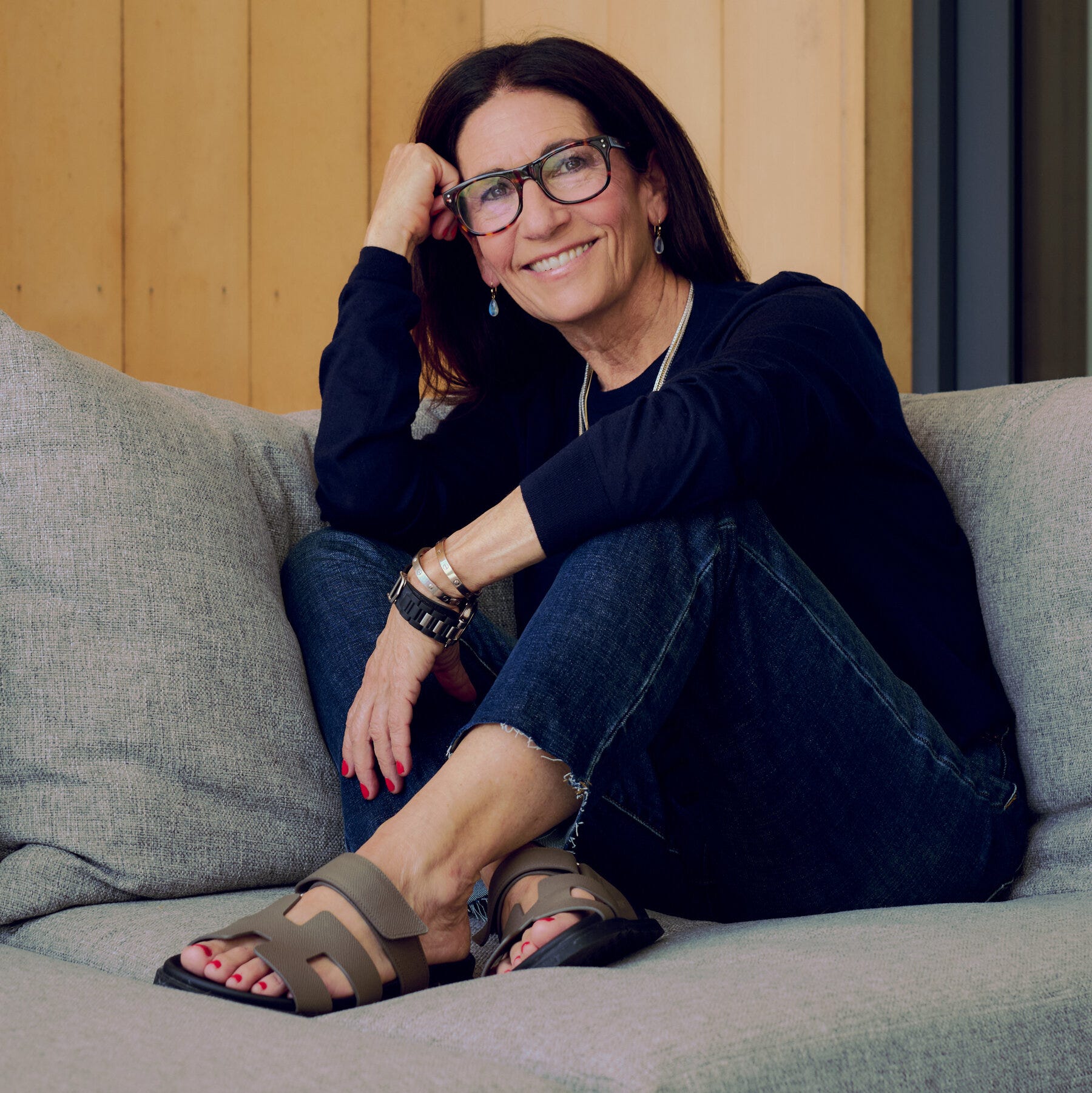
In 1990, a young makeup artist in New York City walked into a drugstore chemist with a single, stubborn idea: she wanted a lipstick the color of her own lips. Not the waxy reds of the decade before. Not the frosted pinks that still clung to the shelves. Just a natural, flattering nude, a lip color that looked like you, only better. That conversation with a chemist changed the beauty industry forever.
Her name, of course, was Bobbi Brown. And what began as a personal frustration became a philosophy, then a product line, then a global brand, then a $74.5 million acquisition, and eventually, the most remarkable second act in modern beauty history.
Chicago Roots, New York Dreams
Born in Chicago on April 14, 1957, Barbara “Bobbi” Brown grew up drawn to the transformative power of cosmetics from an early age. As a self-described insecure teenager, “the teeniest of all my friends,” she once recalled, makeup gave her a sense of agency over how she presented herself to the world. The style she gravitated toward was instinctively her own: soft, natural, the opposite of her mother’s Twiggy-era glamour.
“When we feel that all eyes are upon on us, it is often difficult
to take chances in expressing our individuality.” - Bobbi Brown
After stints at the University of Wisconsin and the University of Arizona, she told her mother she wanted to drop out. Her mother’s advice was characteristically wise: pretend it’s your birthday and do whatever you want. Brown went straight to Marshall Field’s to play with makeup. She enrolled at Emerson College in Boston, graduating with a degree in theatrical makeup and photography. “When I found Emerson, I found myself,” she has said.
In 1980, she moved to New York with an amateur portfolio and no contacts, just a phone book and what she describes as blissful naïveté. She looked up “makeup” and “models” in the Yellow Pages and started making calls. It is a detail that says everything about who she is: relentlessly curious, unafraid to ask, and constitutionally incapable of waiting to be discovered.
Ten Lipsticks That Changed Everything
Through the 1980s, Brown built a reputation as a magazine makeup artist celebrated for her naturalistic touch, a radical stance in a decade defined by Studio 54 drama, Liza Minnelli glamour, and the kind of look-at-me colors that seemed to shout from every cosmetics counter. Brown kept her palette quiet. She emphasized skin. She made women look like themselves.
“I want to make a lipstick that isn’t greasy, isn’t dry, doesn’t smell like my mother’s lipstick, and actually looks like the color of my lips.”
— Bobbi Brown
In 1990, she brought that idea to a drugstore chemist who agreed to develop ten natural-toned shades — and to become her business partner. He would make the lipsticks; they’d split the $15 price point fifty-fifty. Brown told a friend about her new project. That friend happened to be an editor at Glamour magazine. She offered to write about it. Brown, not yet understanding what public relations was, said: “Why would you want to do that?”
The Glamour article ran with Brown’s home phone number. Orders flooded in. The “no makeup makeup” revolution had begun.
Bergdorf Goodman and an Empire in a Day
In 1991, Brown and her husband, Steven Plofker, partnered with another couple to formally launch Bobbi Brown Essentials. The debut took place at Bergdorf Goodman, the iconic New York luxury department store. Brown set a humble goal: sell 100 lipsticks in a month. She sold 100 in a single day.
The debut in numbers: Ten shades of lipstick. One department store. A goal of 100 units in a month. Sold out in a day. By 1995, the brand was beating Estée Lauder in every store where they competed side by side.
Word spread quickly. Brown’s instinct that women wanted to enhance rather than mask their natural features turned out to be a cultural hunger that the industry had entirely missed. The following year, she expanded into yellow-toned foundation sticks, tackling the other great frustration of the era: foundations that turned ashy or orange on real skin. The brand grew into a full cosmetics line, then into department stores across the country.
Selling to Estée Lauder — On Her Own Terms
By the mid-1990s, Bobbi Brown Cosmetics was beating Estée Lauder in department stores across the board. Leonard Lauder, the company’s then-CEO, noticed. He invited Brown and her husband to dinner at his apartment overlooking Central Park. She told him the brand wasn’t for sale.
He kept asking. Eventually, he made an argument that broke through. “What if I can promise you that we can grow your business and you could do what you love,” he told her, “and you keep doing all of the creative, we do everything else — and you can be a really good mom and have your family and not spend your life traveling?” Brown said yes.
In 1995, Estée Lauder acquired Bobbi Brown Cosmetics for a reported $74.5 million. Brown stayed on as Chief Creative Officer, retaining creative control of the brand. Under the Lauder umbrella, the company expanded globally. By 2006, the brand was reportedly generating half a billion dollars in annual revenue. A freestanding retail store with a makeup artistry school opened in Auckland in 2011.
Brown became more than a brand; she became a public figure. She appeared for fourteen years as a regular beauty contributor on NBC’s Today show. She wrote nine bestselling books on beauty and wellness. She served as Editor-in-Chief of Yahoo Beauty. Presidents noticed: Barack Obama appointed her to the Advisory Committee for Trade Policy and Negotiation.
The Exit She Didn’t Expect to Regret
When she sold the company, Brown had signed a non-compete agreement that would prevent her from launching a competing beauty brand for 25 years. At the time, it seemed like a formality. She had no plans to leave.
But the nature of the brand gradually shifted under corporate ownership. By the end of her tenure, she found herself being asked to approve products she hadn’t developed and didn’t believe in. “I’ve always only put my name on things I believe in,” she said later. “At the end of my tenure, I was forced into approving things that I never had a chance to approve. I refused.” In December 2016, she stepped down from the company that bore her name.
“I never put my name on something that I don’t believe in.”
— Bobbi Brown, on leaving her namesake brand
There were still four years remaining on the non-compete. For the first time in her adult life, Brown had time to think. She went back to school simply because it was the first time she could. She became a certified health coach through the Institute for Integrative Nutrition. She explored wellness products, fragrances, and an eyewear collection. She co-designed a boutique hotel, The George, in her hometown of Montclair, New Jersey. She waited.
Jones Road: The Brand She Actually Wanted to Build
On October 26, 2020, the precise day her non-compete agreement expired, Bobbi Brown launched Jones Road Beauty. The timing was not subtle, and it was entirely intentional.
The name came from Jones Road in Montclair, a street near her home. The philosophy was an evolution of everything she’d believed since those first ten lipsticks: the world doesn’t need more beauty products. It needs better ones. Jones Road launched as a “clean beauty” brand, formulated without parabens, phthalates, sulfates, and other potentially harmful ingredients. The original lineup included balms, moisturizing cream colors, mascaras, glosses, washes, and eye pencils, many designed to be multifunctional, used on cheeks, lips, and lids alike.
Jones Road’s founding principle:
“The world doesn’t need more beauty products, it just needs better beauty products.” Clean formulations. Multifunctional products. A curated range that doesn’t overwhelm. Launched during the pandemic, the day Brown’s non-compete ran out.
The launch coincided with Brown joining TikTok, where she began posting straightforward, no-nonsense tutorials aimed at women over 50. It was an unconventional move. TikTok had been largely understood as a Gen Z platform, but Brown’s videos found a hungry audience that had rarely been spoken to directly by the beauty industry. In one characteristic video, she challenged contouring trends directly: “Why would you want to contour your nose?” she asked, explaining how she’d learned to embrace her own features instead.
What Her Story Means
Bobbi Brown’s career is, at its core, a story about conviction. The conviction that women deserve makeup that makes them look like themselves. The conviction that a product is only worth putting your name on if you believe in it. The conviction that starting over, even at 63, during a global pandemic, in a saturated market, is always possible if you have something genuine to say.
She has become, as Allure magazine once put it, the world’s patron saint of natural makeup. But the more instructive part of her story isn’t the first brand, the lipsticks, the acquisition, the empire. It’s what came after.
It’s the woman who walked away from a $500-million business because they asked her to approve things she didn’t believe in. It’s the woman who spent four years in the wilderness, took health coaching classes, renovated a hotel, and then launched a cleaner, leaner, more honest brand on the exact day she was legally allowed to.
The world, she has always believed, doesn’t need more beauty products. It just needs better ones. And Bobbi Brown has spent her entire career proving, twice over, that she knows exactly what better looks like.
“I've always felt best when I can just be me.”- Bobbi Brown
New article every Tuesday.
Be Bold. Be Real. Be Anomalous.
Follow for more Be Anomalous stories, conversations, and behind-the-scenes.
Website | Instagram | LinkedIn | YouTube | @iamsaimenon