


One of the biggest ways to access customers from two different worlds is through brand colloboration and it is the age-old marketing technique used by business owners of any size. While I was recently reading an article about Glow Recipe's collaboration with Beautyblender, it got me thinking which collabs work and which don’t. What are some of the principles to follow?
How a collab actually works
Think of it like a strategic friendship with a purpose.
When two brands collaborate, they’re essentially saying: you have something I don’t, and I have something you don’t, so let’s combine them, and both come out ahead. That something could be an audience, a distribution network, a technology, a reputation, or simply a cultural moment.
At its most basic level, a brand collab is a value exchange.
What makes it different from just buying what you need is that a collab keeps both brands intact and independent. You’re borrowing each other’s strengths for a defined period, for a defined purpose, and then you each walk away having grown.
The business mechanics that sit underneath that simple idea are contracts, IP ownership, revenue splits, exclusivity terms, and exit clauses. But the instinct that drives the best collabs is much simpler: find a partner whose strengths fill your gaps, make sure your strengths fill theirs, and build something neither of you could have built alone.
6 Types of Brand Collaborations
Co-created products: Brands design and launch something new together.
Joint marketing campaigns: Brands team up on shared promotions to reach a wider audience.
Sponsorships: One brand supports another’s event or initiative for visibility.
Content collaborations: Brands create content together to engage their audiences.
Licensing agreements: One brand allows another to use its IP for co-branded products.
Influencer partnerships: Brands work with influencers to build trust and reach.
Two that got it right
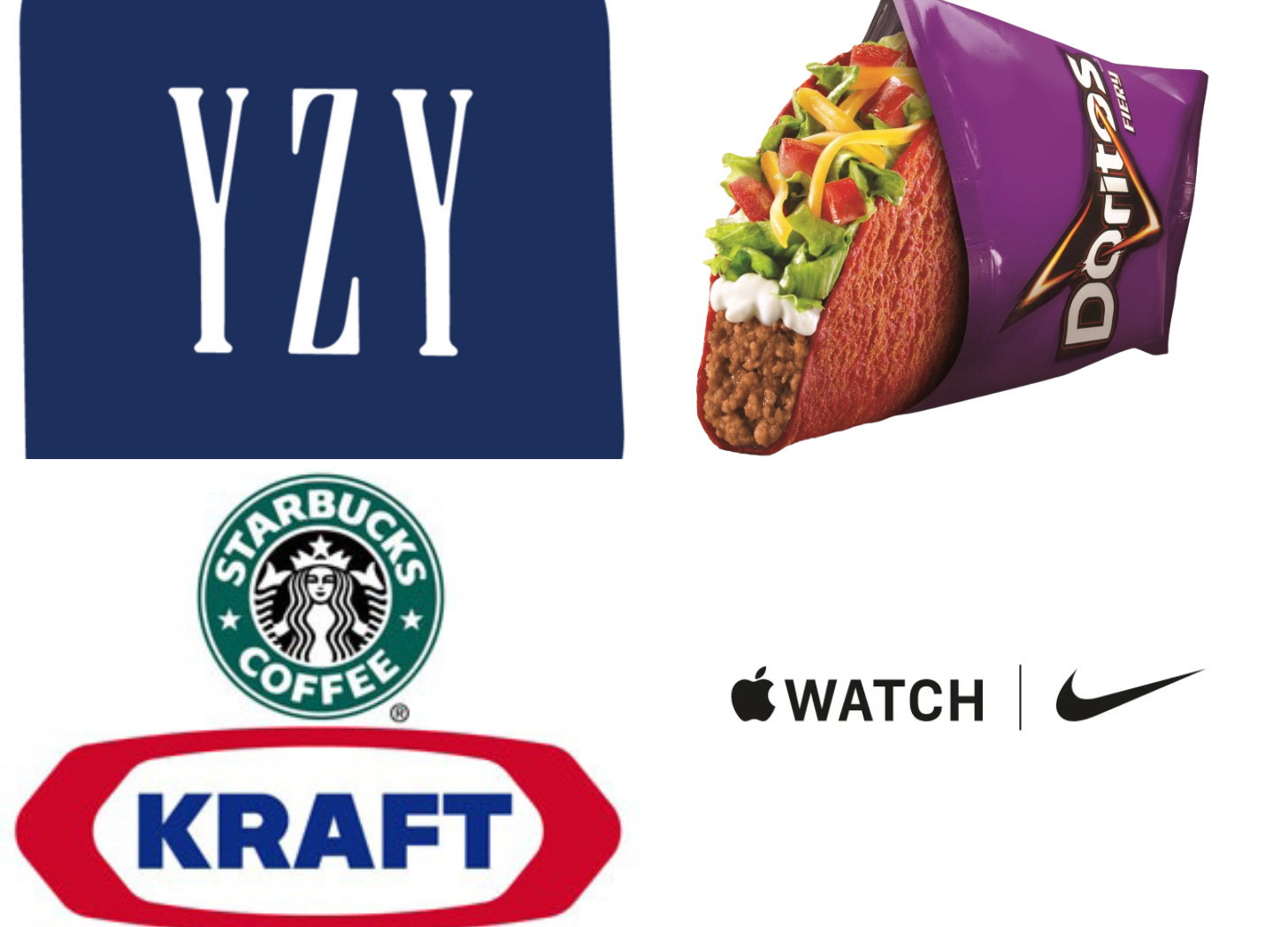
Nike + Apple: when hardware meets movement
In 2006, Nike and Apple released Nike+, a sensor embedded in a shoe that synced with an iPod to track your run. It sounds obvious in retrospect, but at the time it was genuinely new: a sports brand and a tech company creating an entirely new product category together.
The partnership worked because the audience overlap was precise, athletes who were already buying both brands, and because each company contributed something the other couldn’t replicate on its own. Nike knew runners. Apple knew software and hardware miniaturization. The result wasn’t a logo slapped on a limited-edition sneaker; it was a product that changed how millions of people exercise. It eventually evolved into the Apple Watch’s core fitness identity.
The lesson: the best collabs create something that genuinely wouldn’t exist without both parties.
Doritos + Taco Bell: a billion tacos
When Taco Bell and Frito-Lay launched the Doritos Locos Taco in 2012, it became one of the fastest-selling items in fast-food history, with over 1 billion units sold in the first year. The premise was almost comically simple: replace the taco shell with a Doritos chip. And internally, it was met with plenty of skepticism. Executives questioned whether the idea was too gimmicky, too niche, too weird for mainstream America.
Development was a grind; it reportedly took three years just to get the shell right, with engineers struggling to transfer the Doritos’ signature dust coating onto a taco shell without it crumbling or flaking off.
But it beat every odd stacked against it. It worked because the brands occupied the same moment in a person’s life. Taco Bell and Doritos are both late-night, casual, unapologetically flavor-forward. The product also created a new reason to visit Taco Bell at all, meaning both brands drove traffic to each other without cannibalizing anything. What looked like a stunt turned out to be one of the most successful food collaborations in history.
The lesson: the most unlikely-sounding collabs can outperform the safe, polished ones because when the fit is instinctively right, customers don't need to be convinced. They just get it.
Two that fell apart
Starbucks + Kraft: the billion-dollar breakup
In 1998, Starbucks partnered with Kraft to distribute its packaged coffee into grocery stores across America. By most measures, it worked. Kraft was good at distribution, sales grew, and Starbucks coffee found its way into millions of homes. But by 2010, Starbucks had outgrown the arrangement and wanted to control its own consumer packaged goods future. So it walked away from the contract early. Kraft refused to go quietly and sued. In 2013, an arbitrator sided with Kraft and ordered Starbucks to pay $2.76 billion, one of the largest contract dispute payouts in consumer goods history.
The lesson: a collab that works commercially can still end in disaster if the exit isn’t handled right. Always know how you’re getting out before you sign on how you’re getting in.
Gap + Kanye West: the deal without guardrails
In 2020, Gap and Kanye West (now legally Ye) announced Yeezy Gap, a high-profile partnership meant to reinvent Gap’s relevance and bring Ye’s design vision to a mass audience. It collapsed in 2022 amid public disputes, missed timelines, and a breakdown in the relationship, culminating in Ye making increasingly erratic and harmful public statements.
The failure had multiple dimensions. Structurally, the deal gave enormous creative control to a single individual with no formal accountability mechanisms for reputational risk, no morals clause with real teeth, and no contingency plan. When Ye’s public conduct became brand-toxic, Gap was stuck. There was also a fundamental tension between Ye’s instinct to create scarcity and chaos (products dropped in garbage bags, delayed releases) and Gap’s need to run a predictable retail operation.
The lesson: always include an exit. Any deal involving a single personality needs contractual protection against the possibility that the person becomes a liability.
Conclusion
Successful collaborations are the ones that truly understand how customers think and shop—and make that experience easier. But for that to happen, the partnership has to be intentional and well thought out, especially in a time when technology and consumer behavior are constantly evolving.
For more in-depth analysis, stay tuned.
New Article drops every Tuesday.
Be Bold. Be Real. Be Anomalous.