



Cassandra Curtis started making baby food in her kitchen. Then came Ari Raz, John Foraker, Jennifer Garner, and $198 million from Wall Street. Here’s the full story—including who actually owns what.
On the morning of February 6, 2026, Cassandra Curtis stood on the floor of the New York Stock Exchange and rang the opening bell.
She was flanked by Jennifer Garner and John Foraker, her better-known co-founders. Cameras pointed mostly at Garner. But Curtis was the one who started this whole thing—alone in her kitchen in 2015, making baby food for her daughter because she couldn’t find anything in stores she actually trusted.
Eleven years later, that kitchen project was worth $845 million.
By the end of that first trading day, Once Upon a Farm had raised $198 million in its IPO, its stock had surged 17%, and what began as a San Diego mom’s frustration had become one of the most compelling food company stories in a generation.
This is how it actually happened.
The Real Origin Story
In 2015, Cassandra Curtis was a first-time mother in San Diego staring at the baby food aisle with the same thought most new parents have: Is this really the best we can do?
Every product was shelf-stable—jars and pouches heat-treated to survive months at room temperature. The process worked. It was safe. But the high heat destroyed nutrients and dulled flavor. Curtis knew it. She was feeding her daughter the nutritional equivalent of a microwaved vegetable.
So she did something about it.
Curtis started researching an alternative technology called High-Pressure Processing—HPP for short. Instead of using heat to kill bacteria, HPP uses intense water pressure. The food gets squeezed at 87,000 pounds per square inch—six times the pressure at the bottom of the ocean. Bacteria are eliminated. Nutrients and flavor are preserved. The product stays fresh.
It had been used in cold-pressed juice for years. Nobody had tried it for baby food.
Curtis launched the first cold-pressed, HPP baby food ever sold at retail. Ten products. She sold them at San Diego farmers’ markets, delivered them in a refrigerated van to parents’ doorsteps, and sold them through a direct-to-consumer website. It was small, scrappy, and completely new.
Meanwhile, on the East Coast, a guy named Ari Raz was doing almost the same thing. He’d started his own cold-processed baby food business, also delivering to homes, also convinced that fresh was the future.
When they found each other, it was the obvious move. Merge, rebrand, and build something bigger together.
They called it Once Upon a Farm.
Enter the Heavyweights
In 2017, a small, promising startup with a great product and almost no money met two people who changed everything.
The first was John Foraker. If you know the organic food industry, you know Foraker. He’d spent fifteen years as CEO of Annie’s, the beloved organic mac-and-cheese brand, taking it public in 2012 and selling it to General Mills for $820 million in 2014. He was, as Garner would later call him, “the Grand Poobah of organic.”
Foraker didn’t just see a baby food company. He saw a category that nobody had properly built yet and founders who’d already proven the product worked. He became an early investor, then joined as co-founder and CEO.
The second was Jennifer Garner.
Garner’s involvement gets complicated fast by the Hollywood angle, so let’s be precise about what she was and wasn’t involved in. She wasn’t a spokesperson paid to appear in ads. She wasn’t a passive celebrity investor collecting royalties. She was a mother of three who’d been searching for exactly this kind of product and couldn’t find it.
“I saw a tiny little company,” she said later, “that offered organic, fresh, refrigerated food that I struggled to find as a mom.” She met Foraker. They shook hands. She joined as a co-founder.
Her formal title: Farmer Jen. Her actual job: everything public-facing. Investor meetings, retail partner relationships, marketing, media, and the Wall Street roadshow. “I love that they see me as part of the sales team, marketing sees me as part of the marketing team, supply sees me as somebody they can send to a farm and chat with our growers,” she told Bloomberg. She was, by any honest measure, a working co-founder—not a brand ambassador with equity.
By the end of 2017, Once Upon a Farm had four co-founders: Curtis as Chief Innovation Officer, Raz as President, Foraker as CEO, and Garner as the brand’s public face and board member.
Now they needed money to actually build it.
The Funding Machine
Growing a fresh food company is expensive in ways shelf-stable companies never have to think about.
Every step of the supply chain has to stay cold. Refrigerated trucks. Refrigerated warehouses. Refrigerated retail space. Every week the product sits on a shelf is a week closer to expiration. And securing that refrigerated shelf space in the first place? That requires proving to skeptical retailers that parents will buy the product fast enough to justify giving up the real estate.
Once Upon a Farm’s funding came from investors who specialized in exactly this kind of challenge:
S2G Ventures focused on sustainable food systems and understood the supply chain complexity. Cambridge Companies SPG brought consumer brand expertise. CAVU Venture Partners, led by Brett Thomas, was the biggest believer. CAVU had made its name backing emerging food and beverage brands through their most dangerous phase—past the startup stage, not yet at a profitable scale.
The crescendo came in March 2022: CAVU led a $52 million Series D round. At that point, Once Upon a Farm had just crossed $100 million in retail sales. The money had one purpose—fund everything needed to reach an IPO. Bigger manufacturing, better systems, more marketing, more people.
Three years later, they were ready.
The Numbers That Got Wall Street’s Attention
From 2018 through 2025, the company grew at about 64% per year. The baby food industry as a whole grows at roughly 2-3% annually. Once Upon a Farm was growing twenty times faster than the category it competed in, had expanded from baby food into snacks, frozen meals, oat bars, and smoothies, and was selling in 22,000 stores—Whole Foods, Target, Walmart, Kroger, Costco, Sam’s Club.
There was, of course, the uncomfortable part: a $52 million annual loss.
Here’s the honest explanation. On each unit sold, the company was actually making money—gross margins improved from 41% in 2023 toward 44% by 2025. But building the infrastructure to sell $226 million worth of fresh food nationally—the cold-chain logistics, the manufacturing capacity, the marketing to maintain 60%+ growth, the team to run a business this size—costs more than the product profits could cover.
This is a deliberate strategy, not a failure. The bet: reach enough scale that infrastructure costs stop growing as fast as revenue, and losses flip to profits. Amazon did this for years. Netflix too. Whether it works for fresh baby food is still an open question.
What convinced investors was the trajectory: gross margins going up, revenue accelerating, brand awareness growing, category leadership established. The IPO was 12 times oversubscribed.
IPO Day
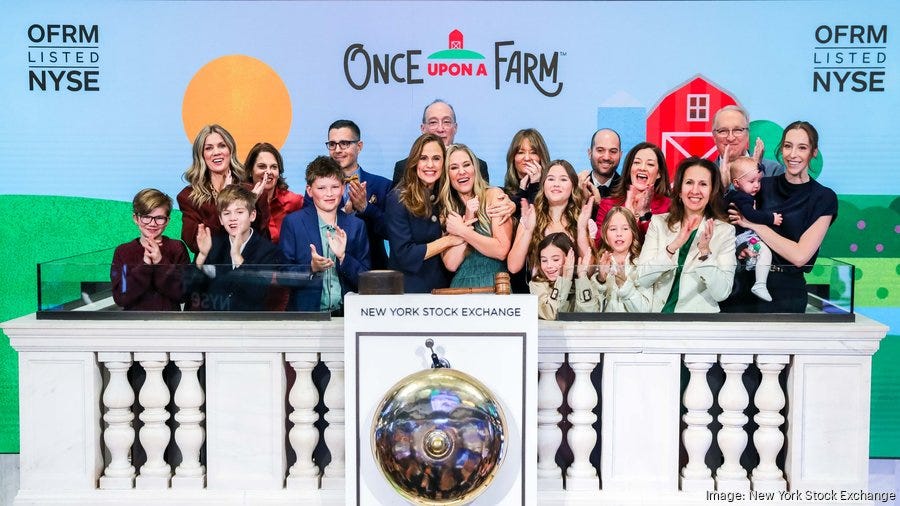
February 6, 2026. A Friday. Garner brought her son, Sam Affleck, to the NYSE. Curtis rang the opening bell. Foraker did press. Employees and their children celebrated on the trading floor.
Once Upon a Farm sold 7.6 million new shares to raise fresh capital for the company. Existing shareholders—including the VC firms and Garner—sold another 3.4 million shares for personal liquidity.
Total raised: $197.9 million at $18 per share, right in the middle of the $17-$19 range.
The stock immediately opened at $21—17% above the offer price. It touched $22 intraday. Closed at $21.05. Market cap: $847 million.
Goldman Sachs, JPMorgan, Bank of America, and William Blair ran the deal. The offering had been more than 12 times oversubscribed.
“The public markets allow us to do that on a bigger stage,” Foraker told Yahoo Finance. Garner called it a chance to “stay true to our values of trying to democratize great food for all kids.”
Once Upon a Farm was the IPO story of the week—proof that the consumer market, mostly shut since 2021’s euphoria, might be ready to reopen.
What Cassandra Built, and What It Means
Step back from the financials for a moment and recognize what actually happened.
In 2015, a mother in San Diego decided the baby food aisle wasn’t good enough. No venture capital. No famous co-founder. A recipe, a refrigerated van, and a conviction that parents would pay for something better.
She built a product that worked. Found a partner doing the same thing on the other coast. Attracted one of the most respected operators in organic food. Partnered with one of the most recognized faces in America. Convinced serious investors to fund the vision. Scaled to $226 million in revenue across 22,000 stores nationwide.
Then rang the opening bell at the New York Stock Exchange.
That’s not a celebrity brand story. That’s a founder story—one that happens to include a celebrity.
What comes next is harder. Once Upon a Farm is public, which means every quarter the numbers are public too. Can they keep growing as the revenue base gets bigger? Can the losses narrow toward eventual profitability? Can they defend their lead as larger food companies wake up to the fresh baby food category?
The skeptics point to the $52 million annual loss and note that Beyond Meat and Oatly ran this same playbook and are now trading at a fraction of their IPO valuations, still unprofitable. The believers point to improving gross margins, genuine brand equity, and a management team with a real track record.
Both are reasonable positions. The answer won’t come for two or three years.
*Once Upon a Farm trades on the NYSE under the ticker OFRM.
New article every Tuesday.
Be Bold. Be Real. Be Anomalous.