


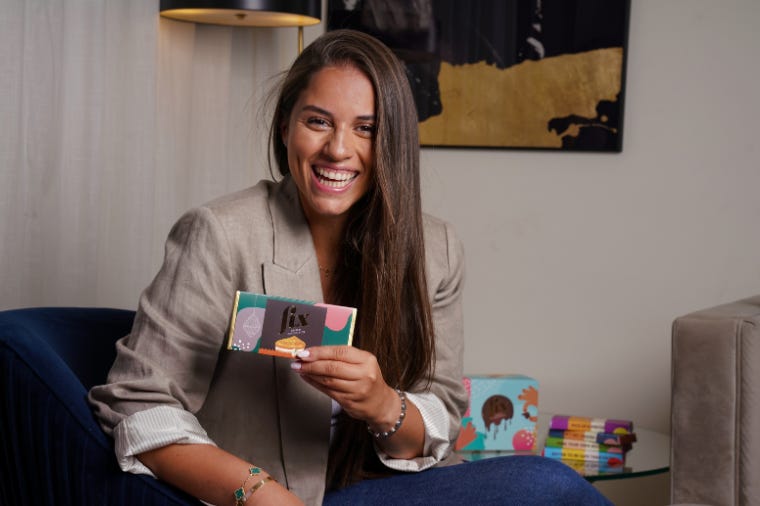
A Craving No Store Could Satisfy
Every great product begins somewhere unexpected. For Sarah Hamouda, it began in a Dubai kitchen in 2021, during her pregnancy, with a craving she simply could not shake. The British-Egyptian entrepreneur, who had been living in Dubai since around 2015, wanted something that did not exist: a chocolate bar that tasted of home, of the warm, layered, syrup-soaked Middle Eastern desserts she had grown up loving.
What she craved, specifically, was knafeh, the beloved Levantine sweet of shredded phyllo dough, soft cheese, and rosewater syrup. What was available to her was, frankly, not that. So she did what any resourceful person with deep food nostalgia and nowhere else to turn would do: she invented it herself.
Working with her husband, Yezen Alani, in their living room, Hamouda began experimenting. She combined pistachio cream and toasted kataifi, fine shredded phyllo pastry, the key ingredient in knafeh, with a touch of tahini, then encased the whole thing in a thick shell of premium Belgian chocolate. The result was extraordinary: a bar that cracked with the authority of fine chocolate, then gave way to a lush, crunchy, nutty, and deeply aromatic interior unlike anything the confectionery world had produced before. She called it “Can’t Get Knafeh of It.”
FIX Dessert Chocolatier, with FIX standing for Freaking Incredible Experience, was born.
The Quiet Years
When FIX officially launched in 2022, selling handmade bars online and through a small Dubai shop, the response was modest. Each bar was priced at £16 (roughly $19.72 USD). At first, the couple was barely selling one bar a week. The bars were extraordinary, the packaging beautiful, the concept genuinely novel. And yet, the world was not listening.
This is the part of the story that is rarely unseen: every founder goes through a phase of anonymity. A product that its founders believed in completely, sitting largely unseen. For most people, this period ends the dream. They conclude the market has spoken. They move on.
Hamouda and Alani did not move on. They kept perfecting. They kept making bars by hand, kept tuning the pistachio cream-to-kataifi ratio, kept insisting that every bar was worth the price they charged. The product remained exactly what it was: exceptional.
What they could not manufacture was the moment that would change everything.
The Video That Broke the Internet
In late 2023, TikTok food influencer Maria Vehera filmed herself doing something simple: biting into a FIX bar. The video was shot in an ASMR-style, unhurried, close-up, and exquisitely attentive to sound. The camera lingered on the crack of the chocolate shell. On the audible crunch of kataifi. On the slow, molten pull of pistachio cream catching the light as the bar split open.
The comments filled almost immediately with a single word: want.
“We want to create an experience, not just a chocolate bar.”
-Sarah Hamouda, Founder of FIX Dessert Chocolatier
The video surpassed 127 million views. Food journalists picked up the story. Travel content creators began flying to Dubai specifically for the bar. Overnight, orders at FIX skyrocketed from single digits to thousands. Hamouda and Alani had to scale their tiny, handmade operation at emergency speed, eventually growing to a team of around 50 people. The $30 artisanal bars began selling out in minutes.
By 2024, “Can’t Get Knafeh of It” had become Deliveroo’s most ordered item worldwide. The global appetite for pistachios surged so sharply that wholesale prices in Turkey, the world’s third-largest pistachio producer, nearly doubled. A chocolate bar had triggered a supply-chain crisis across an entire agricultural sector.
Why It Actually Worked
It would be easy to credit TikTok and stop there. But viral moments do not come from mediocre products. Maria Vehera’s video worked because the bar was genuinely worth filming. The visual drama that split-second crack, that green ribbon of cream existed because FIX had engineered it precisely. The cream was made to a consistency that stays luscious and pulls dramatically on camera. The kataifi was toasted for texture. The tahini, as one food writer noted, is the “secret weapon that most people don’t notice consciously but would immediately miss.”
FIX was also culturally authentic in a way that resonated globally. This was not a multinational food company applying a “Middle Eastern trend” as a seasonal flavour. This was a British-Egyptian woman, rooted in Dubai, drawing on a dessert she had loved her whole life, and making it better than it had ever been made in chocolate form. The product carried a story that felt real because it was real.
And critically, FIX never chased scale before quality. Every bar is still made in Dubai. The recipe has not been diluted. The experience Hamouda promised in 2021 is the same one a customer receives today, shipped directly from the original kitchen. That integrity is what turned buyers into believers, and believers into the unpaid marketing army that sustains the brand.
After the Flood
Going viral is not a finish line. For FIX, it was the beginning of a gauntlet. The bar’s production capacity at the time of the viral explosion was just 500 bars per day, each one handcrafted, the interiors piped by a team working six to eight hours a shift. Now the world wanted millions. Rather than abandon the handmade process and chase volume, FIX made a choice that would define its future: it would protect the product, even if that meant refusing to meet demand.
The bars continued to drop exclusively on Deliveroo in Dubai, twice a day at 2 pm and 5 pm, routinely selling out in minutes. The scarcity was not manufactured; it was real, but it had the effect of manufactured scarcity: it made every bar feel like an event. Resellers began importing bars and marking them up sharply on third-party sites. People flew to Dubai, some specifically to bring bars home. Hamouda watched this happen and, by most accounts, chose not to exploit it.
Then the corporate giants moved in. Lindt launched a limited-edition Dubai-style bar in December 2024. It became the Swiss company’s top-selling travel retail product, shifting over 2.2 million tablets and expanding to more than 100 airports worldwide. Trader Joe’s launched a $3.99 version, made in Turkey, that created its own social media wave. Walmart, Shake Shack, Crumbl, Starbucks, Baskin-Robbins, and Dunkin’ all released Dubai chocolate-inspired products. The hashtag #dubaichocolate accumulated 13.8 billion TikTok views by early 2025. Chocolate-pistachio flavour combinations on restaurant menus rose 22% year-over-year. FIX had not just made a bar; it had invented a category.
Where FIX Stands Today
By late 2025, FIX was no longer just a Dubai delivery phenomenon. The brand expanded into Dubai International Airport, the world’s busiest international airport, first with a single pop-up that proved so popular it had to extend its stay multiple times, then growing to permanent stands in both Terminal 1 Concourse D and Terminal 3 Concourse B. Dubai Duty Free reported that over 1.2 million FIX bars were sold in a single month, generating $22 million in sales.
In October 2025, FIX made its first territorial expansion beyond Dubai, landing in Abu Dhabi exclusively through Deliveroo, a milestone Hamouda described as a major step in the brand’s journey. The bar also began shipping to over 100 countries worldwide, delivering directly from the Dubai kitchen to international customers. FIX had grown from a team of two in a living room to a staff of around 50, building what has become one of the standout small-brand success stories in modern travel retail.
In September 2024, Dubai’s Crown Prince, Sheikh Hamdan bin Mohammed Al Maktoum, publicly endorsed the bar, a moment of cultural legitimacy that few artisan food brands ever receive. FIX created an exclusive flavour for him in response. The bar had become, in the words of one commentator, a form of gastrodiplomacy, an accidental ambassador for Middle Eastern culture, one crack of chocolate at a time.
As for the market FIX created, the brand’s own analysis places “Dubai chocolate” in a transition from viral trend to permanent category somewhere between the croissant (eternally beloved) and the cronut (fondly remembered). New flavours have joined the lineup, from “Catch Me If You Pecan” to “Baklawa 2 The Future” and “Pick Up a Pretzel,” each a witty, punny extension of the FIX universe. The recipe is still secret. Every bar is still made by hand. And the bars still sell out in minutes.
A pregnancy craving that began in a Dubai living room in 2021 had, within four years, reshaped global chocolate consumption, triggered a worldwide pistachio shortage, sparked legal battles across three countries, and placed a boutique confectioner from the UAE at the centre of one of the most genuinely interesting business stories of the decade.
New article every Tuesday.
Be Bold. Be Real. Be Anomalous.
Follow for more Be Anomalous stories, conversations, and behind-the-scenes.
Website | Instagram | LinkedIn | YouTube | @iamsaimenon