


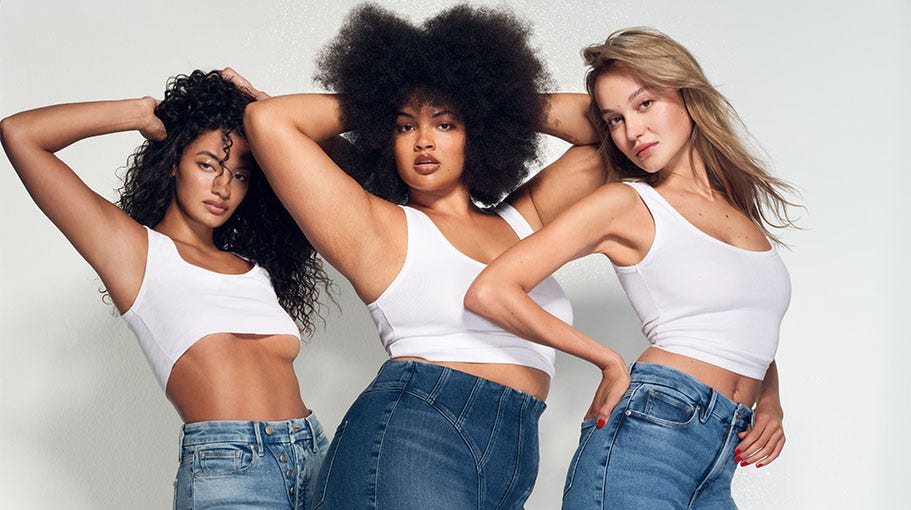
Act I: The pitch that started everything
Emma Grede didn’t have the birth lottery. Raised by a single mother in East London, she saved wages from a paper route to buy fashion magazines, glossy, airbrushed worlds that felt a million miles from her own life. But instead of being bitter about that gap, she became obsessed with it.
At 26, she founded ITB Worldwide, her own entertainment marketing agency in London. Over the next decade, she built relationships with some of the biggest names in fashion and entertainment and eventually relocated to Los Angeles, where an opportunity of a lifetime awaited.
In 2015, at Paris Fashion Week, she was introduced to Kris Jenner. She fixed a meeting, and Emma walked in with a single, focused idea.
“I wanted to take a pain product something women genuinely struggled with and solve it. Denim was that product.”
She pitched the idea to Khloé Kardashian, and something clicked immediately. “I pitched her that idea and a light bulb went off in her head, and she literally finished my sentences,” Emma recalled. “I knew in that moment that Khloé was the person I wanted to work with.”
Two women from very different worlds found themselves finishing each other’s sentences over a shared frustration. That alignment was the seed of everything that followed.
Act II: The launch that broke records
Before Good American officially launched in October 2016, Emma and Khloé hosted a casting call at Milk Studios in New York. They hoped maybe 10 women would show up. Around 5,000 came.
That wasn’t a fluke. It was a signal and proof that the market they were targeting was enormous, underserved, and hungry.
On launch day, Good American went live online and at select Nordstrom locations. In the first hour, they recorded $1 million in sales. By the end of the day, another million. It was the largest denim launch in history.
$1 million in the first hour. The largest denim launch in history.
This was a well-thought-out strategy. It was a brand that had identified a real problem, built a genuine message around it, and showed up with the receipts to prove they meant it. Good American launched with sizes 00 through 24, the widest range in the industry at the time.
Act III: The order they said no to
Within weeks of launch, a major retailer came calling with a significant wholesale deal. It could have accelerated the brand’s growth overnight.
There was one condition: they would only carry sizes 0 through 8.
Emma and Khloé said no.
Before working with any retail partner, they had established a non-negotiable rule: any store that carried Good American had to stock its full-size range and display it in one place, with no separate “plus-size” floor.
“We’re going to have a company based on a set of principles, because we don’t want to negotiate every step of the way.”
For a brand that was just weeks old, turning down a major retailer was a genuinely scary decision. But it told the world and its customers exactly who Good American was. When they said they were inclusive, they were backing it up with actual business decisions that cost them real money.
Act IV: From jeans to a movement
After launch, the founders studied their data obsessively. In 2018, they noticed that 50% of their returns were coming from customers in sizes 14 and 16. The fashion industry had historically jumped from 14 to 16, leaving a gap.
Good American created a size 15.
That decision illustrates something profound about how they operated: they listened to what customers were telling them through their behavior, not just their words. They responded with a product solution.
That same year, they expanded beyond denim into activewear and ready-to-wear. The brand expanded its retail footprint to include Nordstrom, Saks, Bloomingdale’s, Anthropologie, and H&M. In 2023, it opened its first physical store at Westfield Century City in Los Angeles.
Today, Good American employs 120 people and generates over $200 million in annual revenue.
The real lesson from Good American
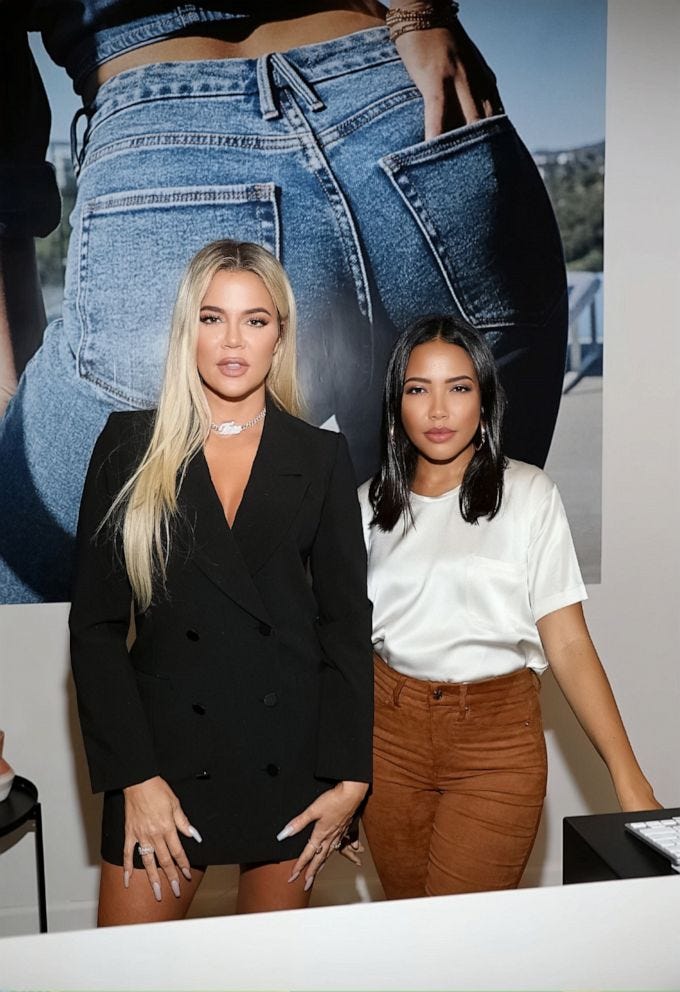
Here’s what most people get wrong when they study a brand like Good American: they look at the outcome and reverse-engineer a fairy tale.
Had a celebrity co-founder, a perfect launch, which would lead to a multi-million dollar business. But that’s not what happened. What actually happened was messier, slower, and far more instructive. A retailer said no to the full-size range, and they walked. Khloe Kardashian gradually stepped back from promotion, and they built anyway. A category expansion didn’t land the way they expected, and they went deeper into their product instead of wider into hype. And when the business hit walls, Emma Grede did what she had always done: got closer to the customer and let the data show her what to do next.
“I didn’t know what could go wrong and so I just got on with things that right now would seem scary or stupid.” -Emma Grede
You will make the wrong bets. You will expand too fast into a category your customers aren’t ready for. You will rely on something, a platform, a person, a moment of trend, that eventually shifts. Every brand makes these mistakes. The ones that survive aren’t the ones that avoided those mistakes. They’re the ones that built something real enough underneath to outlast them.
You need to be like Emma Grede, the one who knows the customer, holds the line, and keeps building long after the glamour of day one has faded.