


The Birth of an Accidental Empire

It was 2008. Gwyneth Paltrow was sitting in her London kitchen, frustrated. The actress had just wrapped filming and found herself thinking about all the wellness tips, recipes, and lifestyle discoveries she’d accumulated over the years—things her friends were constantly asking about. So she did what any reasonable person would do: she started typing up a weekly email to share with them.
She needed a name. Someone told her that successful internet companies often had double O’s in their names (think Google, Yahoo). She combined that insight with her own initials, GP. Thus, Goop was born, not with a business plan, but as a glorified group chat with friends.
The first newsletter was sent out in September 2008 from her home kitchen. No venture capital. No business model. Just Gwyneth hitting send.
What happened next would take 16 years and transform that humble email into a controversial, conversation-dominating, $250 million wellness empire with its own Netflix shows, a restaurant chain, and yes, a candle that supposedly smells like Gwyneth Paltrow’s vagina.
The Long Game: Building Trust Before Selling Anything
For the first few years, Goop made almost no money. By 2011, when the company was officially incorporated, it had generated just $100,000 in sales mostly from advertising, sponsored content, and the occasional affiliate commission.
Here’s where Goop’s story gets interesting and where it diverges from almost every influencer playbook written since. For four years, Goop didn’t sell a single thing.
By 2012, when Goop finally dipped its toe into commerce with a $95 t-shirt collaboration with Kain Label, the newsletter had built something invaluable: trust. That shirt sold out almost immediately. The audience was ready. They’d been waiting.
This patience would prove to be Goop’s secret weapon. By the time it started selling, people weren’t just buying products; they were buying into a lifestyle they’d been reading about for years.
By 2014, Goop had grown beyond a passion project. The newsletter boasted 700,000 subscribers with remarkably high open rates. Gwyneth realized she had something real, but she needed help scaling it.
Goop secured $10 million in Series A funding from heavyweight investors, including New Enterprise Associates and Lightspeed Venture Partners.
The Pivot: From Curator to Creator
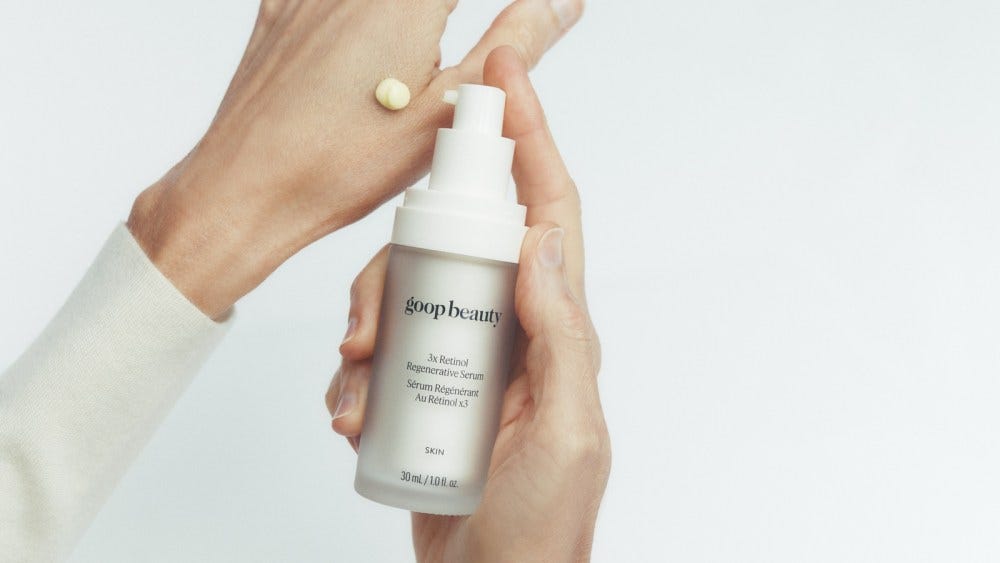
For years, Goop had been primarily a curator, recommending other people’s products. But in 2016, the company made a strategic shift that would define its future: it started creating its own products.
First came Goop Beauty, a partnership with Juice Beauty creating organic makeup and skincare. Then G. Label, a fashion line. In 2017, the company launched Goop Wellness, a supplement line that sold over $100,000 worth of product on its first day.
This wasn’t just about margins (though private label products certainly helped those). It was about control. Goop could now create exactly what its audience wanted, infused with the brand’s aesthetic and values from the ground up.
By 2019, product sales accounted for 70% of Goop’s revenue. Fashion alone would eventually comprise 52% of all sales on goop.com. The company that started as a newsletter had become a full-fledged consumer products company.
Controversy as Rocket Fuel
Let’s address the elephant in the room: Goop has been controversial from the start.
Jade eggs. Vaginal steaming. Psychic vampire repellent. Coffee enemas. The company has promoted products and practices that have drawn fierce criticism from the medical community, led to lawsuits, and made Goop the subject of countless think pieces and late-night comedy sketches.
In 2018, Goop paid $145,000 to settle a consumer protection lawsuit over unsubstantiated health claims about its jade eggs and other products. The scientific community regularly debunks Goop’s claims.
But here’s the thing: the controversy never stopped Goop from growing. If anything, it amplified it.
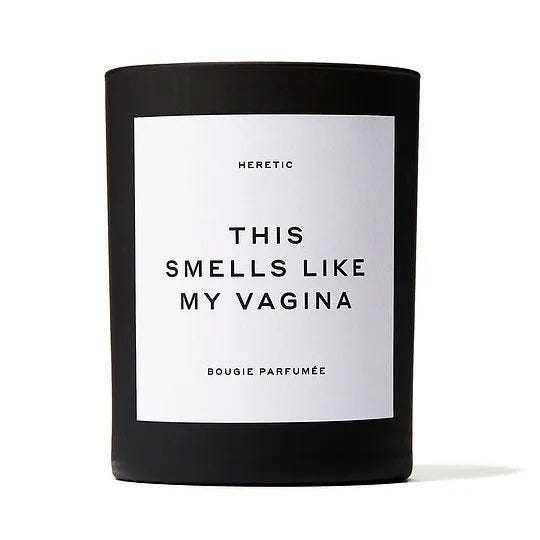
Every criticism became free publicity. Every outraged article drove traffic. The $75 candle called “This Smells Like My Vagina” became international news, selling out almost instantly and spawning a follow-up called “This Smells Like My Orgasm.” Whether people loved or hated Goop, they were talking about Goop.
Gwyneth seemed to understand something fundamental about modern marketing: in an attention economy, being talked about is more valuable than being liked by everyone.
The Multi-Front Expansion: Media, Mass Market, and Restaurants

By 2020, Goop was no longer just an e-commerce company—it had evolved into a full-fledged media and lifestyle empire executing on multiple fronts simultaneously.
The newsletter reached nearly 1 million subscribers with open rates exceeding 20%—astronomical in the email marketing world. The website attracted over 3 million monthly visitors. The podcast, launched in 2018, hit number one on Apple Podcasts with audiences between 100,000 and 650,000 weekly listeners. Then came the Netflix deal: “The Goop Lab” premiered in January 2020, giving Goop a global platform to showcase its brand of wellness and self-exploration. The series was renewed for a second season later that year. In 2021, “Sex, Love & goop” arrived, a series focused on couples exploring intimacy.
These weren’t just partnerships; they were long-form advertisements for the Goop lifestyle, reaching millions of potential customers who might never have visited the website. The content-to-commerce flywheel was complete.
But Goop wasn’t satisfied with dominating the premium space alone. It launched Goop Clean, a mass-market line sold at Target and Amazon with products under $40. This strategy was working: by 2024, Goop Beauty had grown 34% year-over-year, and the G. Label fashion line grew 42%.
And then came the most ambitious expansion yet. Goop launched Goop Kitchen in 2021, a home delivery service that would eventually expand into physical restaurants. In 2024, the company closed a $15 million funding round for the concept, with investors including Uber founder Travis Kalanick. It was an ambitious bet that the Goop brand could extend from your bathroom counter to your dining table.
Three major expansions—media, mass market, and restaurants—all happening within a five-year window. Goop was betting that its brand could stretch across every aspect of lifestyle, from what you watch to what you buy to what you eat.
The Valuation: From Kitchen Table to Quarter-Billion
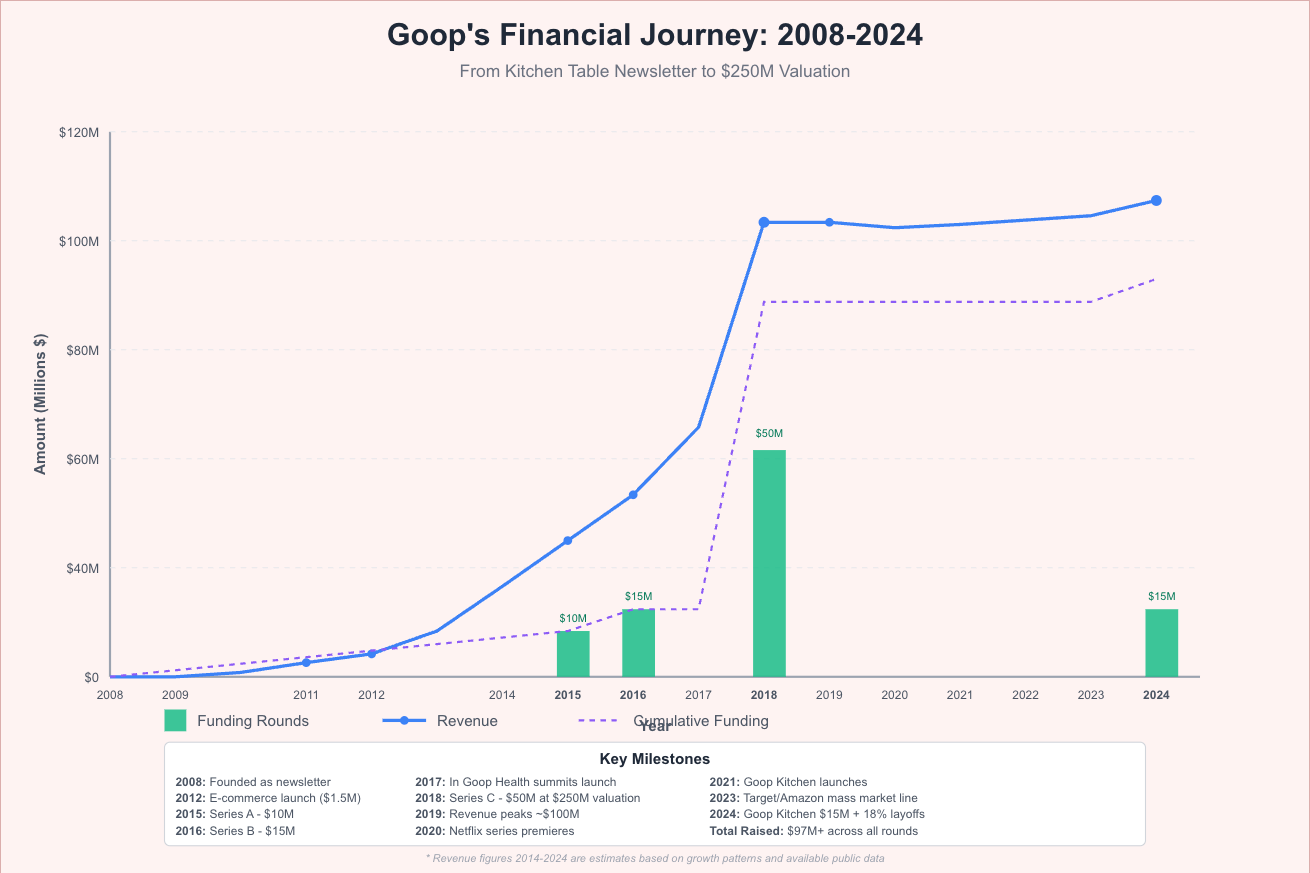
By 2018, after raising a $50 million in Series C, Goop’s valuation hit $250 million. Total funding reached $82 million. The company that started as a weekly email has become one of the most valuable lifestyle brands in the world.
The financial trajectory was impressive. Current estimates put annual revenue at around $100 million. For a company that didn’t sell a single product until year four, that’s a remarkable achievement.
The Founder Factor: Gwyneth’s Irreplaceable Role
Throughout this entire story, one constant remains: Gwyneth Paltrow herself. Unlike many celebrity brands where the famous face is just a logo, Gwyneth is genuinely involved in Goop’s operations. She writes newsletters. She appears on the podcast. She’s the face of In Goop Health events. She’s in the Netflix shows.
This creates both an advantage and a vulnerability. The advantage: authenticity and engagement that keep the community connected. The vulnerability: Goop is inextricably tied to one person’s reputation, interests, and eventual retirement.
Can Goop outlive Gwyneth’s active involvement? That’s the multi-million dollar question investors and executives are surely pondering.
The Legacy: What Goop Actually Built
Love it or hate it, Goop changed the game.
It proved that patience could pay off, and that building an audience before monetizing could create deeper loyalty. It showed that controversy, handled right, could be fuel rather than poison. It demonstrated that a lifestyle brand could become a legitimate multi-vertical business spanning products, experiences, media, and retail.
Most importantly, Goop pioneered the integration of content and commerce in ways that dozens of brands have since copied. The “shoppable lifestyle” that dominates Instagram, TikTok, and creator economy platforms today owes a debt to what Goop figured out on its website years earlier.
Sixteen years later, Goop is still evolving, still controversial, and still very much in the conversation. For a company that started as a weekly email to friends, that might be the greatest achievement of all.
New article every Tuesday.
Be Bold. Be Real. Be Anomalous.