


![David Senra's Ideas from the Greatest Founders in History [Updated 2025] — Eric Jorgenson](https://substackcdn.com/image/fetch/$s_!qs6w!,f_auto,q_auto:good,fl_progressive:steep/https%3A%2F%2Fsubstack-post-media.s3.amazonaws.com%2Fpublic%2Fimages%2Fb63c11cb-0100-441f-982e-e943c8f1abd2_2400x1240.png "David Senra's Ideas from the Greatest Founders in History [Updated 2025] — Eric Jorgenson")
In 2010, a friend dragged David Senra over to watch Joe Rogan’s show on a scrappy livestreaming service called Ustream. Senra wasn’t a media guy. He wasn’t chasing a platform or a following. He just sat there and had the thought that would eventually rearrange his entire life: he could listen to something this raw, this long, this unfiltered, whenever he wanted, from his phone. It rewired something in him. Six years and several failed businesses later, that couch-side revelation became a podcast recorded alone in a Miami kitchen, with a hundred-dollar microphone and absolutely no plan for how it would ever make money.
Every Business Before This One Was a Test Run
Senra had been starting businesses since he was eighteen, detailing cars and boats, then a company called RoboDB that tracked the origin of robocalls. None of it failed. He was pulling in what he called “dentist or doctor money,” comfortable, unremarkable, the kind of income that quiets people down instead of pushing them forward. But nothing he built held his attention the way a good biography did, and it never had, not since he was a kid discovering there was nowhere quite as absorbing as someone else’s whole life laid out on a page.
That restlessness matters, because it explains why Senra didn’t wait for permission or a market signal before he started Founders. He’d already spent a decade proving to himself he could build things that worked financially and still felt hollow. What he was chasing wasn’t a bigger business but a one that he cared enough to know the result didn’t matter.
The Debt Nobody Talks About
Senra’s grandfather was not an educated man. He worked as a butcher, then in a factory that made shoes or socks; even Senra isn’t sure which anymore. In 1959, in his late thirties, married, with a newborn son who would grow up to be David’s father, he watched Castro take over Cuba and made a decision: leave, with no English, no money, and no education, and start over in a country that owed him nothing.
Senra has said, without flinching, that the family that followed wasn’t an easy one to grow up in. He was the first person in his family to graduate high school, the first to graduate college, and in his own words, “the first male in my family not to go to prison in three generations.” He worked full-time during the day and went to the University of Central Florida at night, because that was the only way he could go to college.
Built With No Producer, Paid For By No One
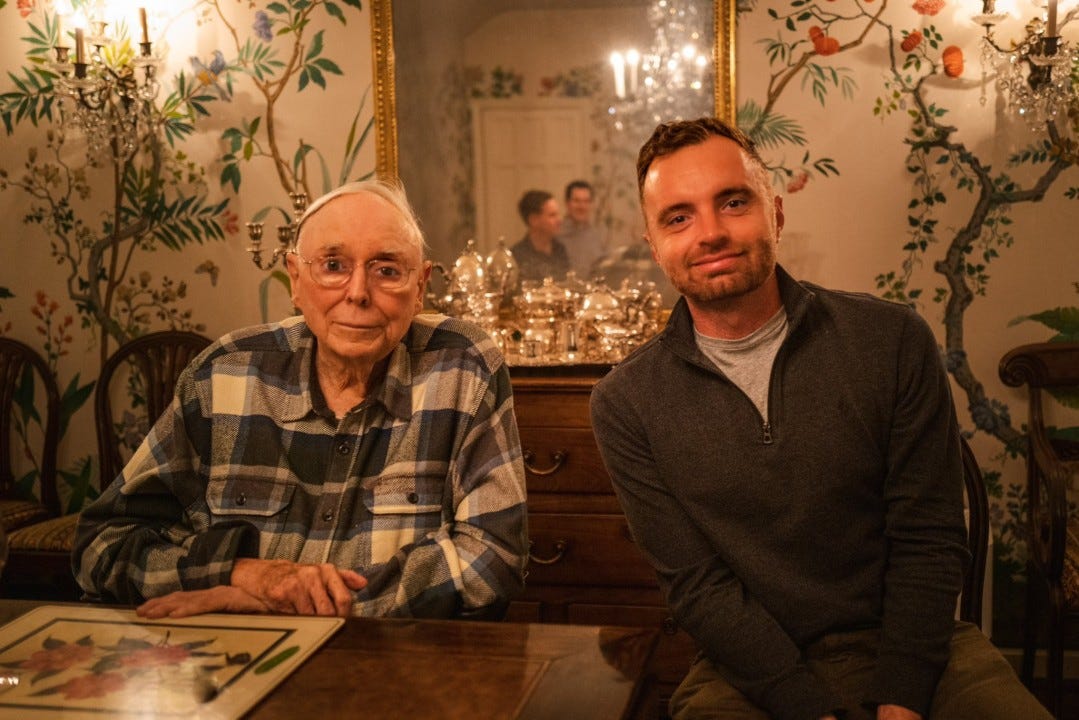
Founders launched in 2016 with no team, no distribution deal, and no safety net. Senra did and still does every part of it himself: choosing the biography, reading it with a pen and a six-inch ruler, marking the pages that mattered, sitting alone in a room, and recording his thoughts out loud. He hosted the show through a small distribution partner called Colossus and made an unusual bet on the business model: the first thirty minutes of every episode were free, and the rest sat behind a paywall.
He kept that structure for six years. Six years of turning away casual listeners at the exact moment they might have gotten hooked, because he believed the work itself had to be worth paying for before he’d let it be free. It was, by any conventional startup logic, a strange way to try to grow. It also meant that the audience he did build in those years wasn’t casual. It was people who’d decided, thirty minutes in, that this was worth their money.
Underneath the recording schedule was discipline. By his three-hundredth episode, Senra had read more than three hundred biographies over a hundred thousand pages and logged every meaningful passage into a reading app called Readwise. He started pulling the sharpest lines from his research and posting them on social media, not as marketing, but as an extension of the reading itself. Those quotes became the thing that pulled strangers toward the show years before most of them ever pressed play on an episode.
The Tweet That Did What No Ad Budget Could
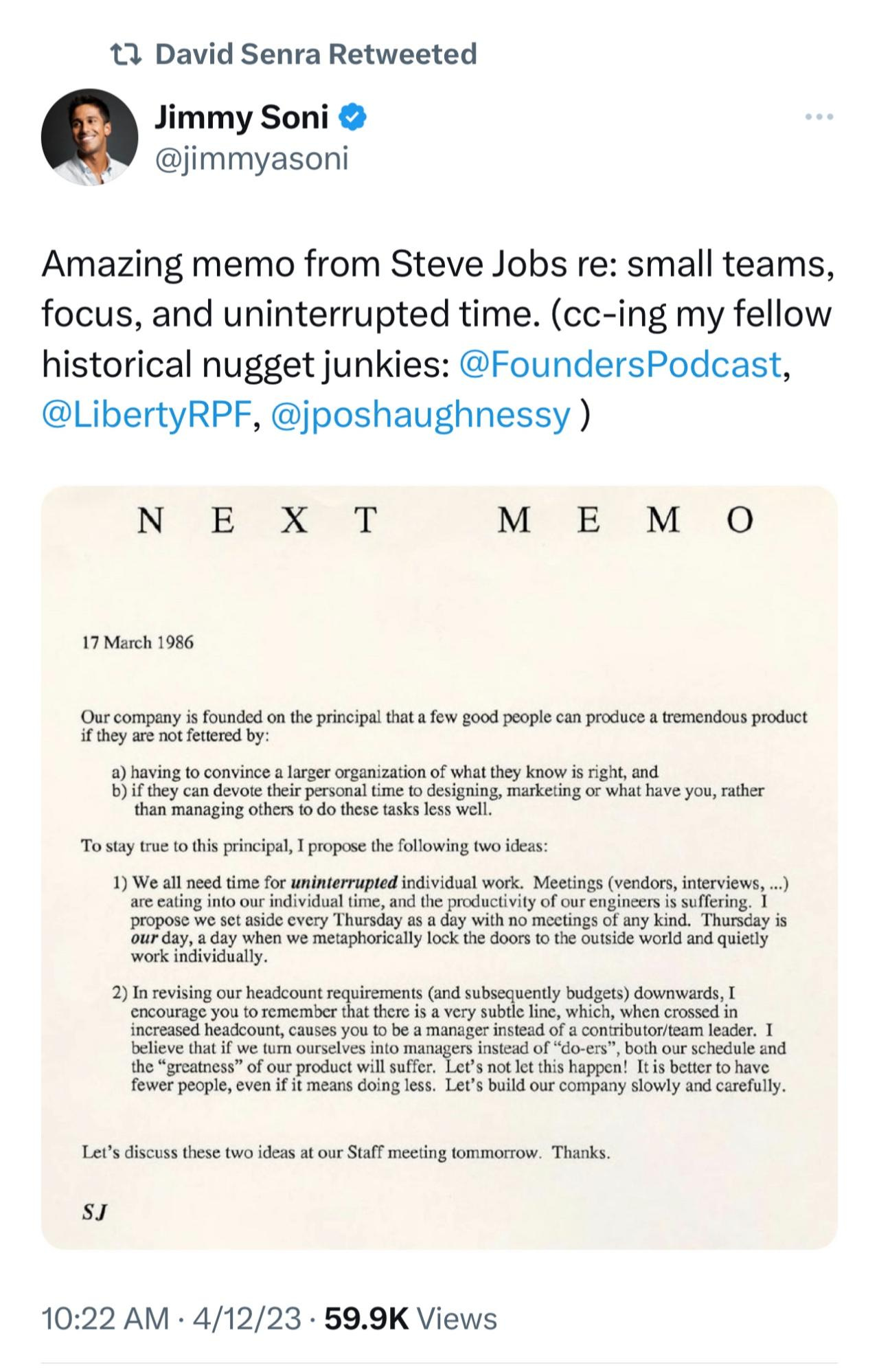
Growth stayed slow and word-of-mouth for years. Then, one May, Patrick Bet-David, a business podcaster with real reach, posted that he never finds new shows worth recommending, except this one. Senra knew Bet-David only in passing. A mutual friend, the former NBA executive Sam Hinkie, connected them properly, and the two hit it off immediately over a shared obsession with entrepreneurship and history. Bet-David didn’t just mention the show once. He kept sending people to it. So did Rob Moore. So did Andrew Huberman, whose own show would go on to dwarf most podcasts in the world.
None of them had a reason to help beyond actually believing in the work. Podcasting, as an industry, tends to reward this kind of unpaid generosity between hosts, and Senra’s growth curve is a direct product of people who owed him nothing choosing to talk about him anyway. By the time listener counts were being seriously tracked, Founders was pulling well over a hundred thousand unique listeners an episode, built almost entirely on people telling other people, rather than on any campaign Senra ran himself.
Choosing Ed Thorp Over the Killers
Nine years and more than four hundred biographies in, Senra has developed a theory: a lot of the most ruthlessly successful people he’s studied are miserable to be around, and often miserable to be. Instead of chasing that version of success, he’s said his real role model became Ed Thorp, the quantitative investing pioneer who made his fortune and then deliberately stopped trading time for more of it, choosing health, family, and curiosity instead. Senra has built his own life closer to that model than to the “killers” he reads about for a living: he keeps his two kids and his wife, who is Colombian, largely out of the public story, and stays rooted near her extended family in Miami rather than chasing the kind of scale that would swallow all of it.
If you had to compress everything he’s learned from nine years and four hundred lives into a single word, Senra has said, it would be focus. ( The irony is, when asked what is the one thing common in all the founders he studied, he said: focus)
Lessons from David Senra
I narrowed down the lessons from David from multiple resources so you don’t have to.
1. Study people who have already done what you want to do
You don’t have to learn everything through your own mistakes. Biographies let you study decades of someone’s decisions, failures, successes, and experiences in a fraction of the time.
Takeaway: Find people who have already achieved something you want and study how they did it.
2. Find something you genuinely care about
The people David studies tend to become deeply invested in something. They’re not simply chasing an outcome, they care about the work itself so the outcome doesn’t matter.
Takeaway: It’s much easier to sustain extraordinary effort when you actually love what you’re doing.
3. Persistence is a competitive advantage
A lot of people quit before their efforts have had enough time to compound. Staying with something for years can become an advantage because your knowledge, skills, relationships, reputation, and opportunities accumulate.
Takeaway: Before abandoning something, ask whether you’ve actually given it enough time.
4. Work extremely hard
Talent helps, but David repeatedly sees extraordinary work ethic among the people he studies.
It’s not just working long hours. It’s being willing to repeatedly do the difficult, boring, uncomfortable work that others aren’t willing to do.
Takeaway: Don’t underestimate how far sustained effort can take you.
5. Think for yourself
Many of the people David studies were willing to disagree with conventional wisdom.
They listened to other people, but ultimately made their own decisions.
Takeaway: Seek advice, but don’t outsource your judgment.
6. Focus requires saying no
You can’t pursue every interesting opportunity. Exceptional people tend to become very selective about where they put their time and attention.
Takeaway: Saying no to good opportunities can be necessary to pursue a great one.
7. Learn from failure without letting it define you
Failure appears constantly in the biographies David studies. Many successful people experienced periods where their businesses, careers, or ideas looked like complete failures.
The difference is that they treated failure as information rather than a permanent identity.
Takeaway: Ask “What did this teach me?” rather than “What does this say about me?”
8. Build before you have validation
David’s own experience with Founders demonstrates this particularly well. He continued producing the podcast for years before it became a major success.
Takeaway: Don’t require other people to believe in your idea before you’re willing to work on it.
9. Obsession can be powerful,but understand what drives it
David has noticed that some extremely successful people were fueled by insecurity, dissatisfaction, or a need to prove themselves.
That energy can produce enormous results, but it can also become unhealthy.
Takeaway: Use ambition as fuel, but eventually try to develop a genuine love for the craft rather than living permanently in a state of needing to prove yourself.
10. Don’t optimize your life only for money
David’s perspective increasingly emphasizes autonomy, ownership, and doing meaningful work, not simply maximizing income.
Money matters, but it isn’t necessarily the best measure of whether you’re winning.
Takeaway: Think about what you want your life to look like, not just your bank account.
11. Protect your attention
The people who accomplish extraordinary things tend to devote an unusual amount of attention to their primary objective.
Constantly switching between things makes deep work much harder.
Takeaway: Your attention is one of your most valuable resources. Spend it deliberately.
12. Become a lifelong learner
David’s entire career is essentially built around continuous learning. He keeps studying people, looking for patterns, questioning what he believes, and updating his understanding.
Takeaway: Don’t think of education as something that ends when school ends.
13. Look for patterns across many people’s lives
One biography can be interesting. Hundreds of biographies allow you to distinguish between one person’s story and recurring patterns.
That’s one of the unique advantages of David’s approach.
Takeaway: When you encounter an idea, don’t immediately assume it’s true. Look for whether the same pattern appears repeatedly.
14. Use history as a shortcut
Human technology changes rapidly, but human behavior changes much more slowly.
Ambition, jealousy, fear, greed, status, competition, friendship, leadership, and relationships existed long before today’s world.
Takeaway: History contains lessons that remain relevant even when the circumstances look completely different.
15. Build something that can compound
The most powerful work isn’t necessarily work that produces an immediate result.
A skill, business, audience, reputation, relationship, or body of knowledge can become more valuable over time.
Takeaway: Prefer activities where today’s work makes tomorrow’s work more valuable.
16. Your circumstances don’t determine your ceiling
The biographies David studies are full of people who started with disadvantages, failed repeatedly, or weren’t initially taken seriously.
Their starting point wasn’t necessarily predictive of where they ended up.
Takeaway: Don’t confuse your current circumstances with your permanent circumstances.
17. The goal isn’t to imitate successful people
Studying someone isn’t about copying their morning routine, personality, business model, or exact decisions.
It’s about understanding how they thought.
Takeaway: Borrow principles, then adapt them to your own circumstances.
“A novice is easily spotted because they do too much. Too many ingredients, too many movements, too much explanation. A master uses the fewest motions required to fulfill their intention.”
David Senra’s story is the one of hope. You choose to do your work with all sincerity, and focus without going into the result because you enjoy it, the results will follow, if not today, not tomorrow, or maybe years later. Your time isn’t the same as anyone else’s, so keep going and believing in yourself.
New article every Thursday.
Be Bold. Be Real. Be Anomalous.
Follow for more Be Anomalous stories, conversations, and behind-the-scenes.
Website | Instagram | LinkedIn | YouTube | @iamsaimenon