


A 13-year-old kid in North Carolina uploads a gaming video to YouTube from a secondhand laptop. A 24-year-old graduate in New York records a podcast about her dating life with her roommate from their Lower East Side apartment. A university dropout in Manchester builds a social media agency out of his bedroom and starts talking into a microphone because he has no one else to tell his ideas to.
None of this looked like the future of media. All of it was.
While television executives were protecting their ad rates and radio programmers were cutting staff and magazine publishers were asking why nobody was reading anymore, a different kind of media company was being built in bedrooms and apartments. Just a camera, a microphone, and an audience that kept getting bigger.
The creator economy, the industry built around individuals who produce and monetize content independently, is now worth an estimated $250 billion globally, and is projected to reach $500 billion by 2030. YouTube’s daily usage passed Netflix worldwide in 2026. Podcasts converted 67% of their listeners into buyers of something. Netflix is now cutting deals to put podcasts on its platform because daytime television is in freefall. The old guard didn’t see the disruption coming because it didn’t come from Silicon Valley or Hollywood. It came from people who just refused to stop posting.
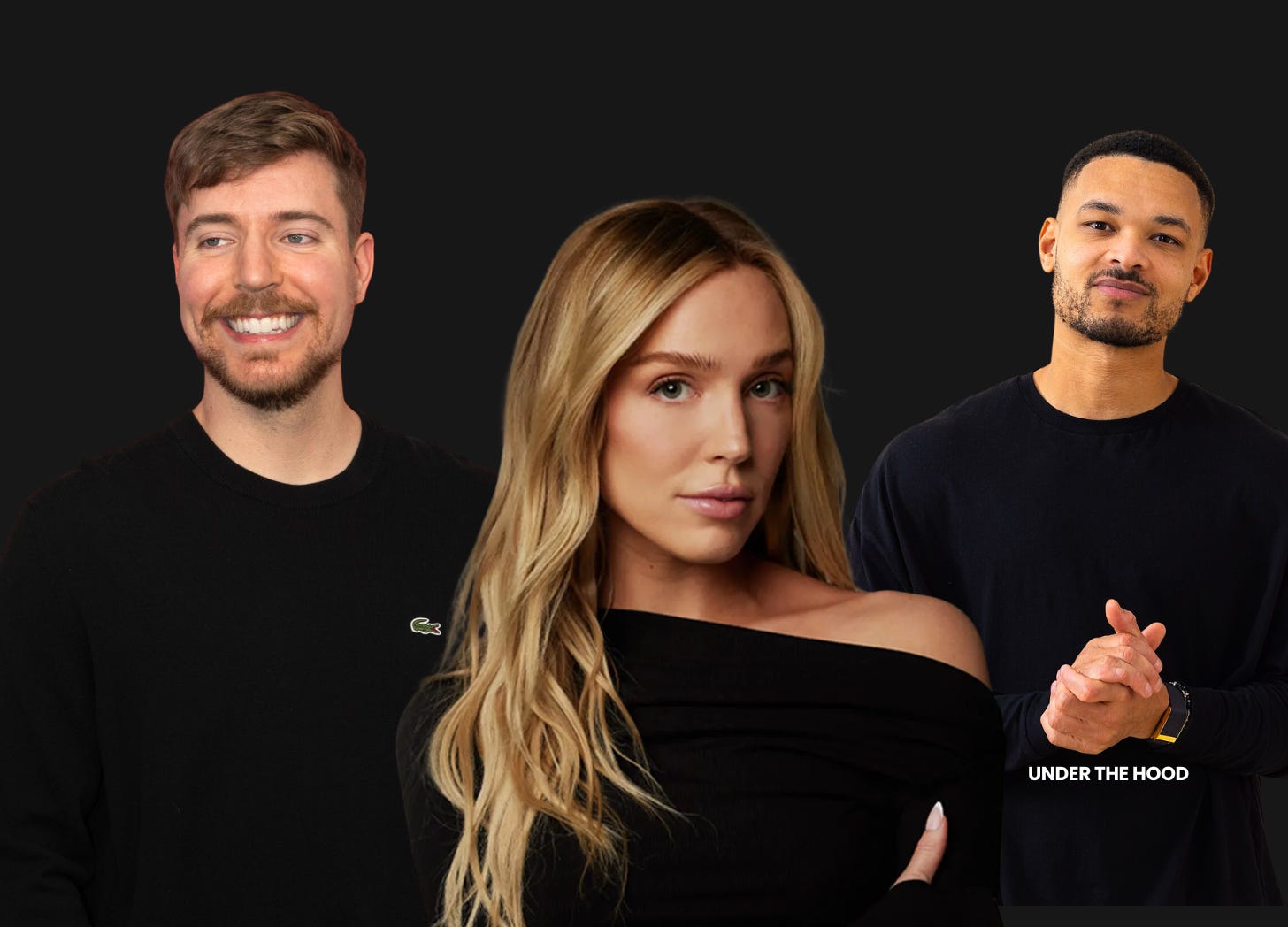
Three of those people, Jimmy “MrBeast” Donaldson, Alex Cooper, and Steven Bartlett, are now building what traditional media always claimed it was: a genuine connection with a massive audience that translates into real money. Here’s how they actually got there.
Jimmy Donaldson Started With Nothing. He Still Acts Like It.
In 2012, a 13-year-old from Greenville, North Carolina, started posting gaming videos. His channel was called MrBeast6000, a name that came from a randomly generated Xbox gamertag. His production quality was terrible. His thumbnails were an afterthought. He spent close to five years posting consistently before he hit a million subscribers.
What he was doing in those early years, though, wasn’t just posting. He was studying the platform obsessively, analyzing what made videos spread, what kept viewers watching, and what the algorithm rewarded. He made videos counting numbers for hours. He ranked other YouTubers’ subscriber counts. He reacted to bad content to attract people who made bad content. None of it was glamorous, but all of it was data. He dropped out of East Carolina University after two weeks because he was editing videos in the parking lot instead of going to class.
The breakthrough came when he stopped trying to optimize the algorithm and started trying to break it. In 2017, he posted a video of himself reading out loud for 24 hours. Then he started giving money away, $10,000 to a stranger, $100,000 buried in a field, and a Lamborghini to someone who kept their hand on it longest. Spectacle as content. Generosity as strategy. The thesis was simple: if the video was worth more to the viewer than anything else competing for their time, they’d watch. They’d share. They’d come back.
It worked. By 2022, he had surpassed PewDiePie to become the most-subscribed individual creator in YouTube history.
How does he make money? Every possible way. YouTube ad revenue from hundreds of millions of views per video. Feastables, the chocolate bar brand he launched in 2022, now sits in over 80,000 retail locations across North America, including Walmart, Target, and 7-Eleven, pulling an estimated $200 million in annual revenue. Beast Industries, the holding company behind all of it, raised at a $5 billion valuation. And then there’s Beast Games, the Amazon Prime Video reality competition where he put up a $10 million prize pool and nearly 5,000 contestants. Amazon made over $100 million in profit from Season 1 within its first four weeks. Season 2 aired in January 2026. Season 3 is in negotiation, with Donaldson reportedly asking $150 million per season, and last week, he reached 500 million subscribers on YouTube.
He is, by every measure, the largest individual media operation in the world. And he still talks about it like a kid who might wake up and find out it wasn’t real.
Alex Cooper Was Told No. She Found a Different Door.
Alex Cooper grew up in Newtown, Pennsylvania, played Division I soccer at Boston University, and had her athletic career ended by a knee injury. She graduated in 2016 and moved to New York to work entry-level media jobs, navigating a dating life in Manhattan she later described as “chaotic in the best and worst ways.”
In 2018, she and her roommate, Sofia Franklyn, started recording a podcast from their apartment. The idea was simple: say the things women actually talk about among themselves but never out loud in public, sex, relationships, ambition, and dating disasters. They called it Call Her Daddy. They uploaded it to Barstool Sports, which gave them distribution and a small salary in exchange for owning the show.
Within two years, Call Her Daddy had become one of the most listened-to podcasts in the country. Then everything almost fell apart. In 2020, a contract dispute with Barstool founder Dave Portnoy became public. Franklyn left. Cooper was left holding a podcast she didn’t fully own, with an audience who’d watched her fight publicly for control of her own work. Instead of waiting for the situation to resolve itself, she negotiated hard, won sole ownership of the show, and kept going alone this time.
In 2021, Spotify signed her to an exclusive deal worth $60 million over three years. In 2024, SiriusXM came with a bigger offer: up to $125 million over three years, with advertising and distribution rights not just for Call Her Daddy but for the entire Unwell Network, the podcast collective she’d been quietly building around herself, backing voices she thought could command the same kind of loyalty she had built. Kamala Harris came on the show during the 2024 election campaign, the same week Donald Trump appeared on Joe Rogan’s. That parallel told you everything about where political press tours had moved.
How does she make money? The $125 million SiriusXM deal is the anchor, but the business underneath it keeps expanding. Unwell Hydration, her electrolyte drink brand, launched in partnership with the National Women’s Soccer League. Unwell Creative Agency launched with Google as its first client, helping brands reach Gen Z through original productions. She directs the creative, earns the ad revenue, owns the IP, and, unlike every radio host or television personality who came before her, keeps the upside from everything she builds on top of it.
Steven Bartlett Dropped Out After One Lecture.
Steven Bartlett was born in Botswana, moved to England at two years old, grew up in Plymouth, and lasted exactly one month at Manchester Metropolitan University before he decided a classroom wasn’t going to teach him what he needed to know.
In 2014, he co-founded Social Chain, a social media marketing agency that understood something most traditional agencies didn’t: that internet communities were the new media channels, and the brands that learned to speak their language would win. Social Chain grew to over 200 employees, landed clients including Apple, McDonald’s, and the BBC, and went public through a merger in 2019. Bartlett, at 27, became one of the youngest people to take a company public in Europe.
He stepped down as co-CEO in 2020. And instead of retiring or starting another agency, he did something most people coming off a nine-figure business exit don’t do: he started a podcast because he wanted to figure out what he’d actually learned.
The Diary of a CEO launched in 2017 while he was still running Social Chain, initially as a personal audio diary, something to organize his own thinking. Over time, it became something else. He started interviewing entrepreneurs, scientists, psychologists, athletes, world leaders, and anyone who’d done something worth understanding. By 2025, Spotify Wrapped ranked it as the second-most-popular podcast globally. It now has over 15 million YouTube subscribers, 70 million monthly downloads, and has passed one billion YouTube views in late 2025.
In October 2025, Bartlett raised a major eight-figure investment for Steven.com, his holding company, at a $425 million valuation, retaining over 90% ownership. The structure underneath it: FlightStory, a media production arm; FlightCast, a podcast hosting platform built natively for video; FlightFund, a venture arm with investments in SpaceX, Whoop, Groq, Replit, and MrBeast. He has backed more than 40 companies. His stated ambition is to build the Disney of the creator economy. This machine takes creator IP and compounds it the way Disney compounded Mickey Mouse into a century-long entertainment empire.
How does he make money? The Diary of a CEO generates an estimated $20 million a year in advertising alone. FlightStory produces content for other creators and brands. FlightFund invests. FlightCast monetizes the infrastructure. And as the youngest-ever Dragon on BBC’s Dragons’ Den, he’s gained equity stakes in businesses that have nothing to do with content at all.
What This All Actually Means
The numbers are one thing. The shift underneath them is something bigger.
Traditional media, television, radio, and publishing were built on a model where the institution owned the audience. A network had viewers. A station had listeners. A magazine had subscribers. The individual on camera or behind the microphone was the hired talent. The distribution was the asset, and the institution held it.
What MrBeast, Cooper, and Bartlett built is the opposite of that. The individual is the distribution. The audience follows the person, not the platform, which is why Cooper can move from Spotify to SiriusXM and take her listeners with her, why MrBeast can launch a chocolate bar and have it in 80,000 stores within three years without a single traditional marketing campaign, and why Bartlett can raise $425 million at 33 and still own 90% of the company. None of them is an employee of the medium they work in. They own the relationship.
This is what “replacing traditional media” actually looks like. Not a dramatic collapse, but a quiet migration of audience trust from institutions to individuals, and with it, a migration of the economics. The ad money that used to flow to television networks and radio stations is now flowing directly to the people audiences chose to spend their time with. YouTube’s daily usage passing Netflix isn’t a quirk. It’s a verdict.
The three people above didn’t plan to build media empires. They started with a camera, a microphone, and something they wanted to say. The audiences found them and then stayed. In a world overflowing with content, that sustained attention turned out to be worth more than anything the old model ever produced.
New article every Tuesday.
Be Bold. Be Real. Be Anomalous.
Follow for more Be Anomalous stories, conversations, and behind-the-scenes.
Website | Instagram | LinkedIn | YouTube | @iamsaimenon