


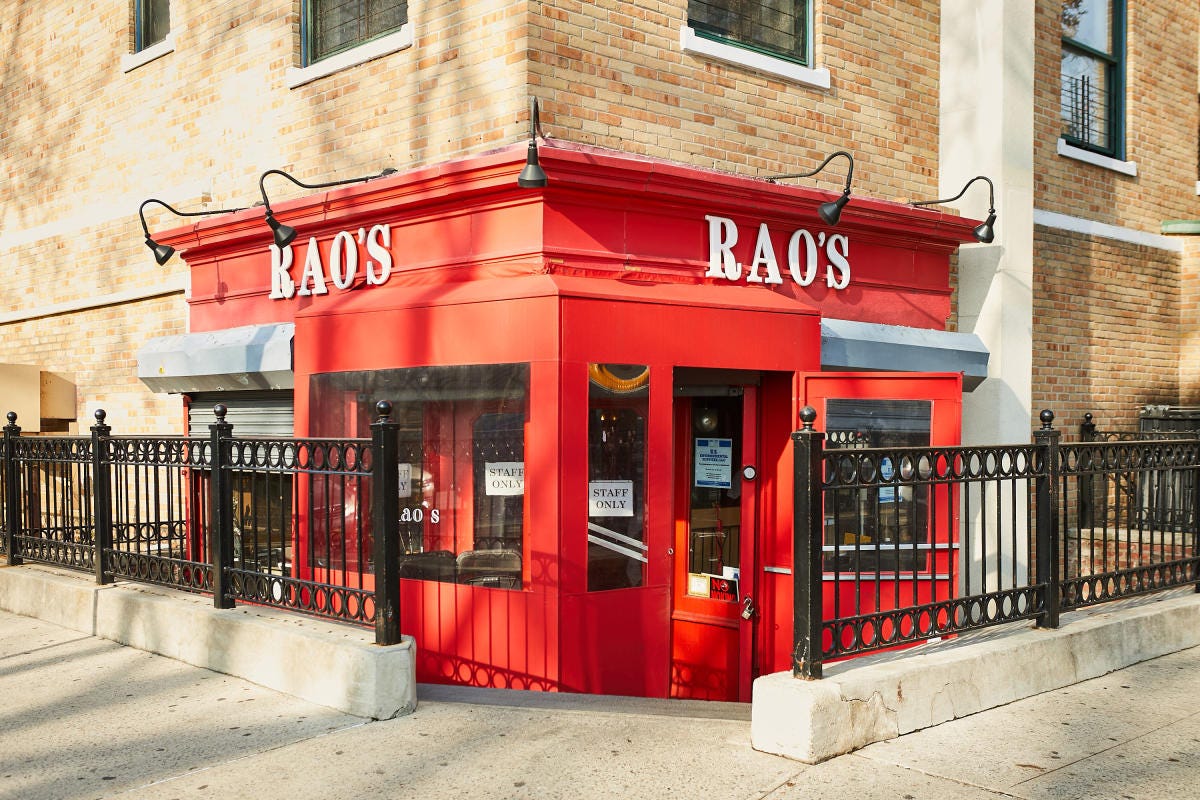
There is a restaurant in East Harlem that has been impossible to get into for over a century.
No reservations or walk-ins. The 11 tables inside are effectively “owned” by a rotating cast of regulars - politicians, mob bosses, celebrities, and New York lifers who have been coming so long the restaurant just holds their table. Everyone else gets turned away at the door. If you somehow land a seat, you’re eating some of the most revered Southern Italian food in the country, in a room that hasn’t changed much since 1896.
That restaurant is Rao’s. And the reason a jar of marinara sauce sitting in your grocery store costs $9 while the jar next to it costs $3 traces directly back to that door that stays closed.
This is the story of how a brand built on exclusion became one of the most acquired products in American grocery history. And how the same scarcity that made it valuable almost made it impossible to scale.
1896: The Original Asset
Charles Rao, an Italian immigrant, opens a small tavern on Pleasant Avenue in East Harlem, a neighborhood then known as Italian Harlem, packed with Southern Italian families who brought their food traditions across the Atlantic. The food is simple, the recipes are tight, and the room is small by design.
Over the next several decades, Rao’s becomes a neighborhood institution. The kind of place where regulars don’t just have a table, they have their table, and it’s understood. Frank Sinatra. Robert De Niro. Politicians who shouldn’t be seen together but are. The room operates on a social currency that money can’t quite buy, and that’s precisely the point.
By the time Frank Pellegrino Sr. takes over, Rao's has become the kind of place people talk about the way they talk about a speakeasy, not as somewhere to eat, but as somewhere you either get in, or you don't. There's no waitlist or PR strategy. The room is just small, and the relationships are just old, and somehow that turned into one of the most powerful brand assets in American food history. Nobody planned it. That's what makes it hard to copy.
1992: The Sauce Leaves the Building
In 1992, the Pellegrino family made a decision that would look, in hindsight, like one of the most consequential CPG moves of the past thirty years: they started bottling the sauce.
It wasn’t a business decision. It was just because people kept asking.
The product that hits retail shelves is functionally identical to what comes out of the Rao’s kitchen: Italian tomatoes, olive oil, fresh onions, fresh basil, and garlic. No water or tomato paste, added sugar, fillers, starches, or colors. In a category where the standard formulation is built around cost efficiency, water-heavy, paste-forward, loaded with stabilizers, Rao’s is doing something that most food manufacturers would call irrational: it’s making the expensive version and charging accordingly.
For years, it has sold quietly. The brand has no real marketing budget, no national distribution, and no growth strategy. It doesn’t need one. The brand equity from the restaurant does the work. People who know Rao’s know Rao’s. Everyone else walks past it.
That’s the paradox starting to form: the scarcity that makes the brand desirable is the same thing capping its ceiling.
2017: Private Equity Sees What the Restaurant Couldn’t
Enter Sovos Brands, a food company freshly formed by Advent International, one of the world’s largest private equity firms. Sovos is built with a specific thesis: find brands with disproportionate consumer love and underdeveloped commercial infrastructure, then pour fuel on them.
Rao’s fits the profile almost perfectly.
Sovos acquired Rao’s Specialty Foods for $415 million in 2017, at a moment when the brand had just $65 million in net sales and household penetration of roughly 1%, compared to the category leaders sitting at over 30%. On paper, that’s an aggressive price for a brand most of the country has never heard of.
But Sovos isn’t buying the sales number. They’re buying the myth.
The operational moves that follow are textbook PE-backed brand scaling, but executed with unusual discipline:
Distribution, sequentially. Rao’s had been a Northeast and West Coast product, available in specialty retailers and some natural grocery chains. Sovos pushes it into Walmart, Kroger, Albertsons, Safeway, and Sprouts, driving double-digit distribution growth every quarter post-acquisition. This isn’t an unplanned expansion to every retailer at once; it’s a controlled, thought-out strategy that protects the premium shelf positioning.
Marketing budget, dramatically. Sovos takes the marketing budget from a few hundred thousand dollars a year to $20 million, with a primary focus on digital, paid media, influencer seeding, and content that lets the brand story do the selling. The narrative writes itself: a 125-year-old New York institution, the impossible restaurant, the sauce that tastes like a place you’ve never been able to get into.
Retailer economics as a sales argument. This is the move that doesn’t get talked about enough. The average profit per jar of Rao’s sits at $2.22, versus $0.40 for the category average, more than five times the margin contribution per facing. When the Sovos sales team walks into a retailer conversation, they’re not asking for shelf space. They’re offering a math problem with an obvious answer.
The scarcity paradox starts to resolve. The brand keeps its premium positioning not by staying small, but by pricing, ingredient integrity, and retailer economics that make mass distribution feel like an upgrade, not a compromise.
2019–2021: COVID Pours Gasoline
The pandemic is a before-and-after moment for Rao’s that no amount of planning could have engineered.
Restaurants close. People are home, cooking every night, and suddenly willing to spend $9 on a jar of sauce because it’s still a fraction of what delivery costs. The consumer who had never bought Rao’s picks it up, maybe because it’s the last jar on the shelf, maybe because they saw it on social media, and then they buy it again. And again.
Rao’s household penetration climbs significantly through this period, converting a trial driven by circumstance into a habitual purchase driven by preference. The product earns that loyalty because it delivers. This is where ingredient integrity stops being a brand story and becomes a retention mechanism.
By the time Sovos prices its IPO in September 2021, Rao’s household penetration has nearly doubled to 9.6% since the 2017 acquisition, still well below category leaders, but moving fast. Rao’s market share in the sauce category reaches an all-time high of 13.2% that same quarter.
Sovos lists on Nasdaq at $12/share. The IPO values the company at around $1.3 billion. Rao’s is the headline asset.
2022–2023: The Growth Becomes Undeniable
In Q2 2022, Rao’s posts 34% dollar sales growth and 28% unit growth versus the prior year. That distinction matters more than it sounds. In CPG, it’s easy to manufacture a good quarter, raise prices, watch revenue climb, and hope nobody notices volume is quietly bleeding out.
Rao’s isn’t doing that. It’s selling more jars, at a higher price, to more households. By 2023, net sales hit $774.7 million, up 33.5% from the year before. Revenue is up 400% since 2019 alone. The brand Sovos bought for $415 million when it had $65 million in revenue is now closing in on $800 million.
The scarcity paradox is fully resolved. The brand that built its identity on being impossible to access is now in every Walmart in America, and somehow it still feels premium. That's the real magic trick: Rao's expanded distribution without expanding its identity. The restaurant stayed closed. The sauce stayed expensive. The ingredients stayed the same.
August 2023: Campbell’s Pays $2.7 Billion
Campbell Soup announces the acquisition of Sovos Brands for $23 per share, for a total enterprise value of approximately $2.7 billion. The purchase price represents a 92% return for Sovos shareholders from the September 2021 IPO price of $12.
The strategic rationale for Campbell’s is clear: they own Prego, a mainstream sauce brand priced at roughly $4 per jar, and they need a premium play. Rao’s is the most compelling premium play in the entire category.
What follows the announcement is a case study in brand anxiety. Fans flood social media with concern that Campbell’s will change the recipe, dilute the ingredients, or do what big food companies historically do to beloved cult brands: optimize them to death. The scarcity paradox resurfaces in a new form. The same consumers who made the brand worth $2.7 billion are now worried that being worth $2.7 billion will ruin it.
Campbell’s CEO Mark Clouse addresses it directly:
“We will not touch the sauce. We have not fundamentally touched the chicken-noodle soup in 125 years.”
The framing is smart. It’s also a strategic commitment that constrains every future decision Campbell’s makes about the brand.
2024 and Beyond: The New Paradox
Under Campbell’s, the scarcity-to-scale paradox takes its final form.
Rao’s becomes the number one sauce brand in all regions of the United States. The brand crosses $1 billion in portfolio sales of sauces, soups, pasta, and frozen meals. Half of all U.S. households purchased Rao’s in the past year.
But the new challenge is hiding in plain sight: even at this scale, brand awareness sits at only 65–67% among consumers walking down the pasta sauce aisle. Campbell’s is running NFL ads, Macy’s Thanksgiving Day Parade floats, Real Housewives partnerships, and the full big-brand media playbook, trying to close that gap.
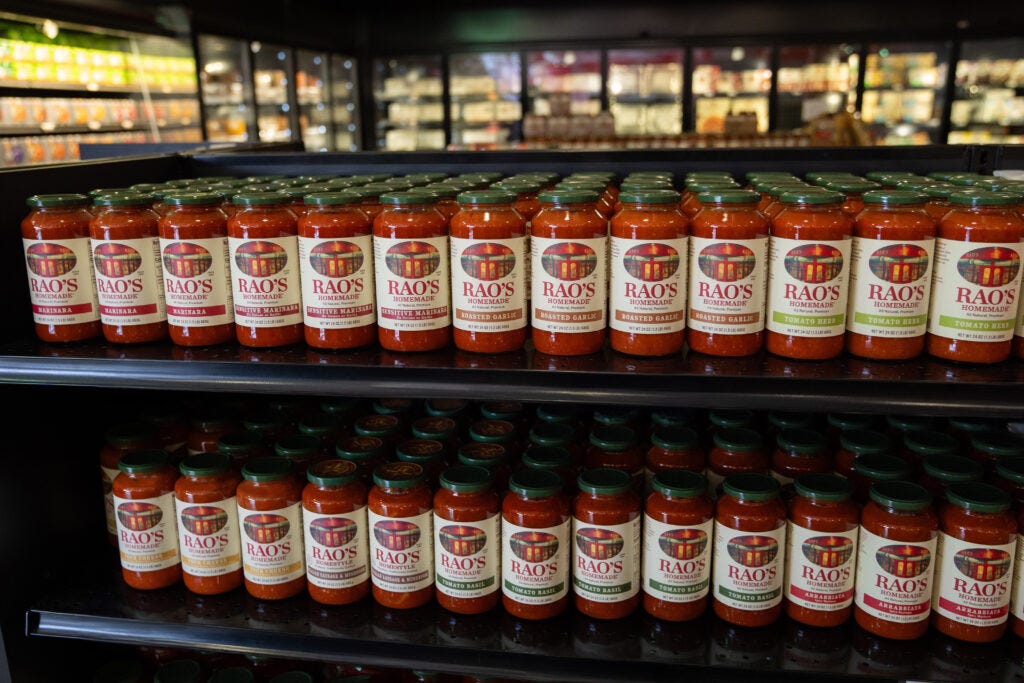
Rao’s SKU count is still only 60% of what Prego offers, which means there’s significant shelf space still uncaptured. Frozen pizza, frozen entrees, and soup represent growth categories where Rao’s currently has minimal presence.
The brand that started as an 11-table restaurant that nobody could get into is now being pushed by one of the largest food companies in the world to reach the 33% of pasta sauce buyers who still haven’t heard of it.
That tension, between the myth that made the brand and the machinery required to grow it, is the defining challenge of Rao’s next chapter.
What Founders Should Take From This
The Rao’s story is often told as a feel-good narrative about an authentic brand that got discovered, but that’s not the case.
The real story is about sequence. The restaurant built brand equity for 96 years before the sauce hit shelves. The sauce built regional loyalty for 25 years before Sovos unlocked distribution. Sovos built the commercial infrastructure, margin story, retailer economics, and marketing investment before selling to Campbell’s. Every stage was built on the credibility established by the stage before it.
Scarcity wasn’t a strategy Rao chose. It was a reality they inherited. But the companies that scaled the brand understood something critical: the scarcity didn’t need to be maintained. It needed to be transferred. The impossibility of the restaurant became the premium of the product. The price point and the ingredients held that premium in place as distribution expanded.
You can scale a brand without diluting it. But you have to decide, from the beginning, what you are and what you will never compromise. For Rao’s, that line was the recipe. Everything else was negotiable.
The door at the restaurant is still closed. The sauce is in 40,000 stores. Both things are true. And that’s the whole playbook.
New article every Tuesday.
Be Bold. Be Real. Be Anomalous.
Follow for more Be Anomalous stories, conversations, and behind-the-scenes.
Website | Instagram | LinkedIn | YouTube | @iamsaimenon