


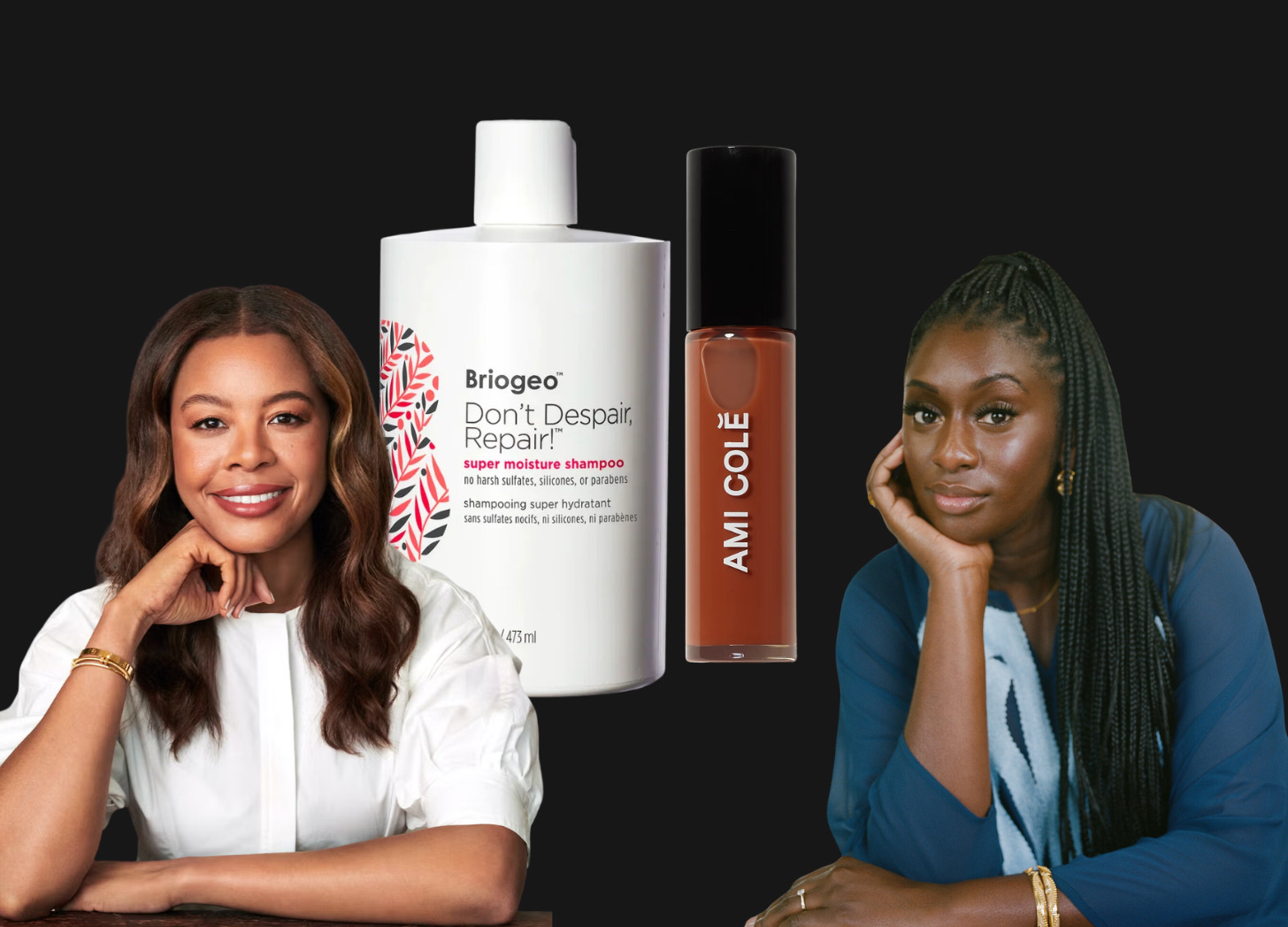
Briogeo and Ami Colé both made it to Sephora’s shelves. Both were Black-founded. Both were beloved. What happened next could not have been more different, and every entrepreneur building a consumer brand needs to understand why.
Getting into Sephora is supposed to be the moment. It’s the validation that your brand is real. It’s the distribution that opens you up to millions of new customers. It’s the press pitch that writes itself. “Now available at Sephora.”
Two brands — Briogeo and Ami Colé got that moment. Both were clean beauty brands. Both were Black-founded. Both built genuine communities of devoted customers. Sephora believed in both of them enough to put them on the shelf.
Briogeo was acquired by Wella in 2022 in a deal that made Nancy Twine one of the most celebrated exits in indie beauty. Ami Colé announced it was shutting down in July 2025, with its founder writing in an essay for The Cut that she couldn’t compete with brands that had deeper pockets and that “prime shelf space comes at a price” she could no longer afford.
Same retailer. Same category. Same cultural moment. Completely different outcomes.
The question worth sitting with: why?
Briogeo: The Goldman Sachs VP Who Made Hair Care Her Life’s Work
Nancy Twine didn’t set out to build a beauty company. She set out to build a life with more meaning in it.

She’d been at Goldman Sachs for nearly a decade, working her way to VP. She was successful, but she was unfulfilled. Then her mother died suddenly, and the loss opened something up. Twine kept returning to memories of her childhood kitchen, where her mother, a physician, would concoct homemade hair and skin treatments from natural oils, butters, and extracts picked up from health food stores.
She started doing what most people do when they’re considering a pivot but still paying rent: she researched obsessively at night. She wrote a business plan on weekends. She contacted manufacturers, talked to chemists, ordered samples, and sent boxes to friends. For a year, she did this while still drawing a Goldman salary.
What she saw in the market was a gap between natural and performance. Most clean hair care felt earnest but ineffective. Most high-performance hair care was full of silicones, sulfates, and parabens that Twine didn’t want on her hair. She wanted both, and she believed other women did too.
She built Briogeo around a simple framework she called “6-free”: no sulfates, silicones, parabens, phthalates, DEA, or artificial dyes. Products that were 93 to 100 percent naturally derived, but that actually worked. The name combined brio, an Italian word for vibrancy, with geo, a nod to the earth. She developed four products. She packed them in sample boxes in her tiny East Village studio apartment.
In 2013, she took those samples to a beauty trade show in Las Vegas. Six months later, she got an email from Sephora. They wanted to carry her line.
Two weeks later, she quit Goldman Sachs.
The Sephora Relationship That Changed Everything
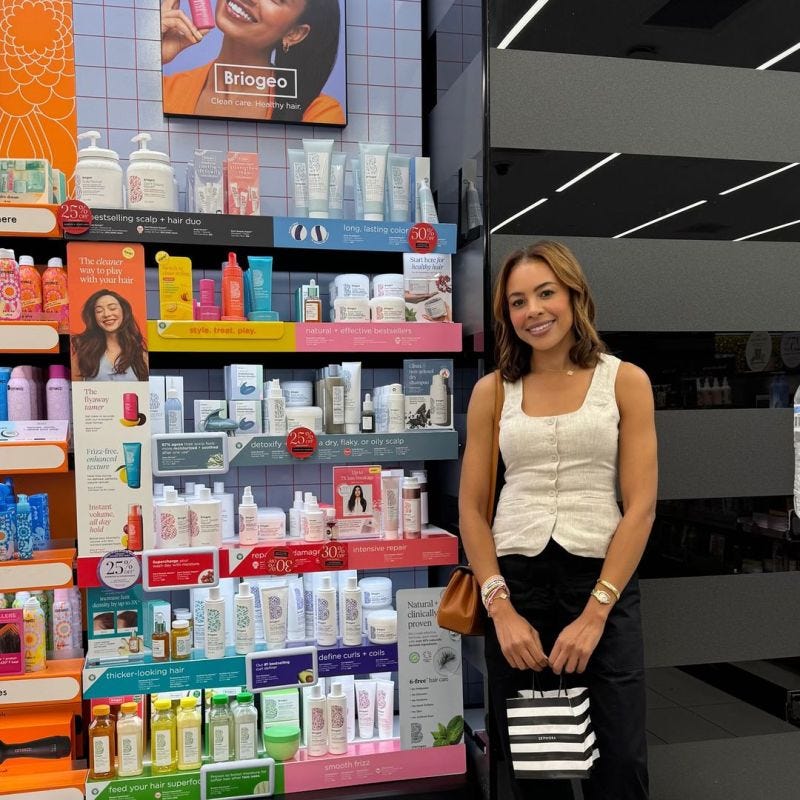
Twine has been direct about what Sephora meant to her: “I’m forever indebted to Sephora because they took a bet on me before anyone else really did. Because of that, we were able to really grow our brand and bring in so many incredible customers from around the world.”
But Twine didn’t just take Sephora’s bet and coast. She understood what it actually required of her to land on that shelf.
She had spent nearly a decade watching Goldman’s clients, some of the most sophisticated businesses in the world, manage financial complexity, capital allocation, and operational risk. She brought those instincts to Briogeo. She didn’t hire fast. She didn’t raise VC money. For six years, Briogeo never took any outside VC or PE investment. Twine funded the business by dipping into her personal savings until the brand became profitable.
She treated Sephora not as a finish line but as a growth channel with its own demands, and she learned those demands intimately. She sampled aggressively because she understood that in prestige retail, trial converts skeptics. She developed hero products that could anchor the line and become reliable repeat purchases. Her Deep Conditioning Mask became one of the most awarded products in Sephora’s hair category, winning the Allure Best of Beauty Award every year from 2018 onward.
She also understood what Sephora couldn’t do for her. It could put her product in front of millions of customers. It couldn’t build her brand. That was her job. She used digital, editorial, and community to pull customers into the brand so that when they walked into Sephora, they were already looking for Briogeo, not just stumbling across it.
The business grew steadily. By 2020, Briogeo had an estimated gross revenue of $40 million. It was one of the top-selling hair care brands on Sephora.com. It had expanded to Nordstrom, Urban Outfitters, and international markets. And then, in 2022, nine years after launching, Briogeo was acquired by Wella Company. At 29, Twine had become the youngest Black woman to launch a product line at Sephora. By her early thirties, she had built and sold one of the most successful indie hair care companies in the country.
Ami Colé: The Right Brand at the Wrong Time
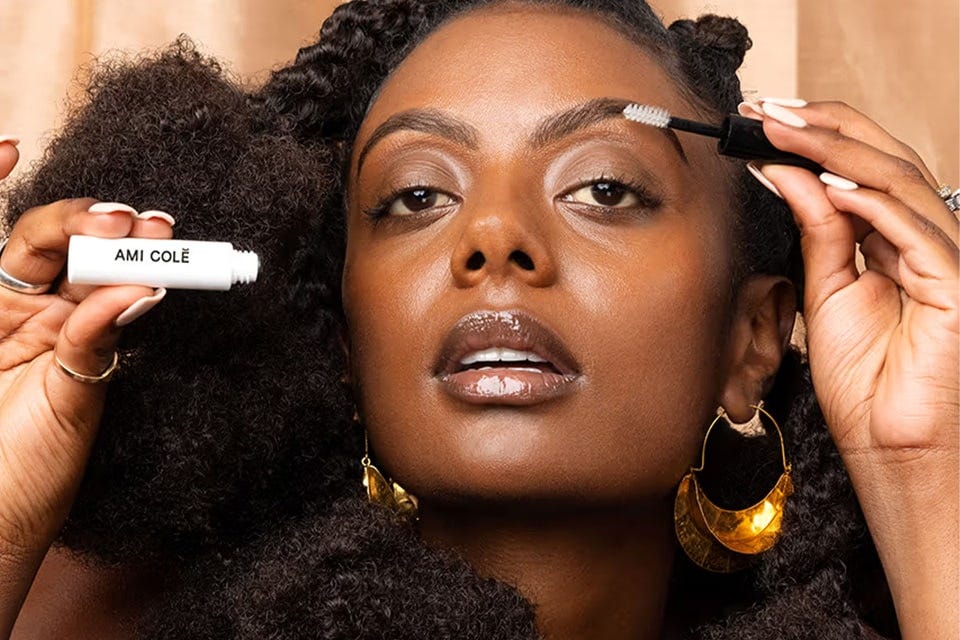
Diarrha N’Diaye-Mbaye’s story starts in a Harlem hair salon. Her mother, Aminata — Ami, for short, ran a salon that was the social and cultural heart of their Senegalese community in New York. Growing up inside it, N’Diaye-Mbaye absorbed something that would shape everything she built: the idea that beauty isn’t just a product, it’s community, culture, identity, and belonging.
She spent a decade working in the beauty industry, at Temptu, L’Oréal, and Glossier, before she tried to build something of her own. She had the idea for years, but the doors kept closing. Investors told her Fenty Beauty already existed, implying the market for Black beauty was somehow complete. She couldn’t get traction.
Then George Floyd was murdered in May 2020. Corporate America responded with a wave of pledges, capital commitments, and public declarations about equity. The Fifteen Percent Pledge launched, pressuring retailers to dedicate shelf space to Black-owned brands. Sephora signed. Investors became, in N’Diaye-Mbaye’s words, “a little bit more sensitive and sensitized to where they sit on the spectrum of equity.”
Within weeks of the uprisings, she received an influx of requests to bring her “deserving brand” to life. She raised over $1 million in pre-seed funding and launched Ami Colé in May 2021 with three products: a skin tint, a lip oil, and a highlighter, all formulated specifically for melanin-rich skin.
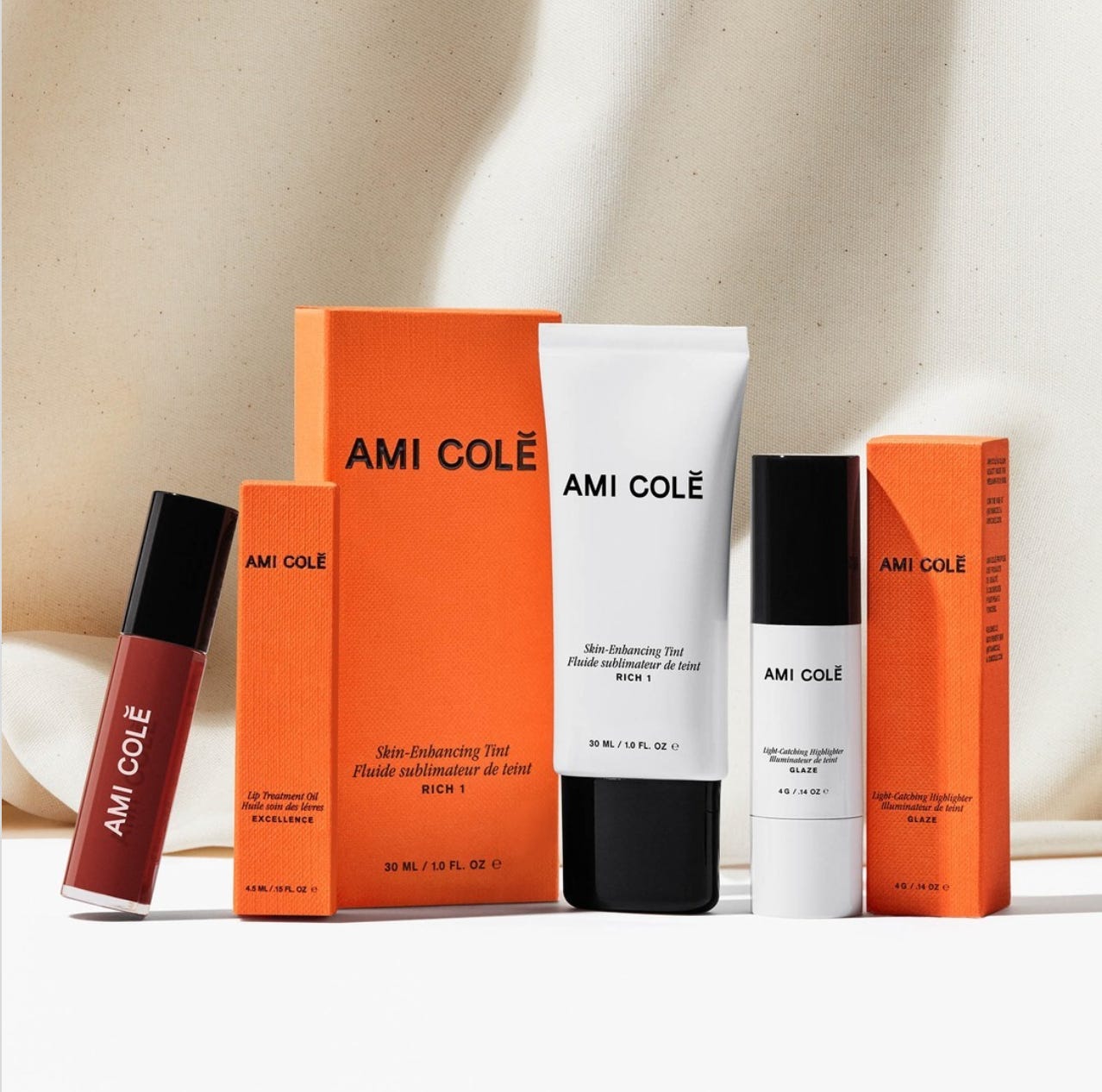
The brand was an immediate cultural hit. Within months of launching, Ami Colé sold out its first run of products, created a viral lip oil that became a staple in makeup bags from Harlem to Accra, and became a favorite among celebrities like Kelly Rowland, Mindy Kaling, and Martha Stewart. It went on to win more than 80 product awards and earned a spot on Oprah’s Favorite Things list.
In December 2022, Ami Colé launched in 277 U.S. Sephora doors, a full-circle moment for N’Diaye-Mbaye, who had worked as a Sephora sales associate during her undergraduate years at Syracuse. By 2024, the brand had expanded to 600 Sephora locations across North America. L’Oréal’s BOLD venture fund made a minority investment.
By every visible measure, Ami Colé had made it.
The Hidden Cost of the Shelf
Here is what the press releases don’t tell you about getting into Sephora at scale: the shelf is not the reward. The shelf is where the real battle begins.
Sephora is not a charity. It is a retailer with aggressive sell-through targets. If a brand doesn’t move product at the pace Sephora needs, it gets moved or removed. To move product at that pace, a brand needs marketing. Not the organic kind, the paid kind. Premium shelf placement, the eye-level spots, and the front-of-store displays are literally purchased. When you walk into Sephora and see stacks of Sol de Janeiro body mists off the bat, that’s their $200 million marketing budget at work.
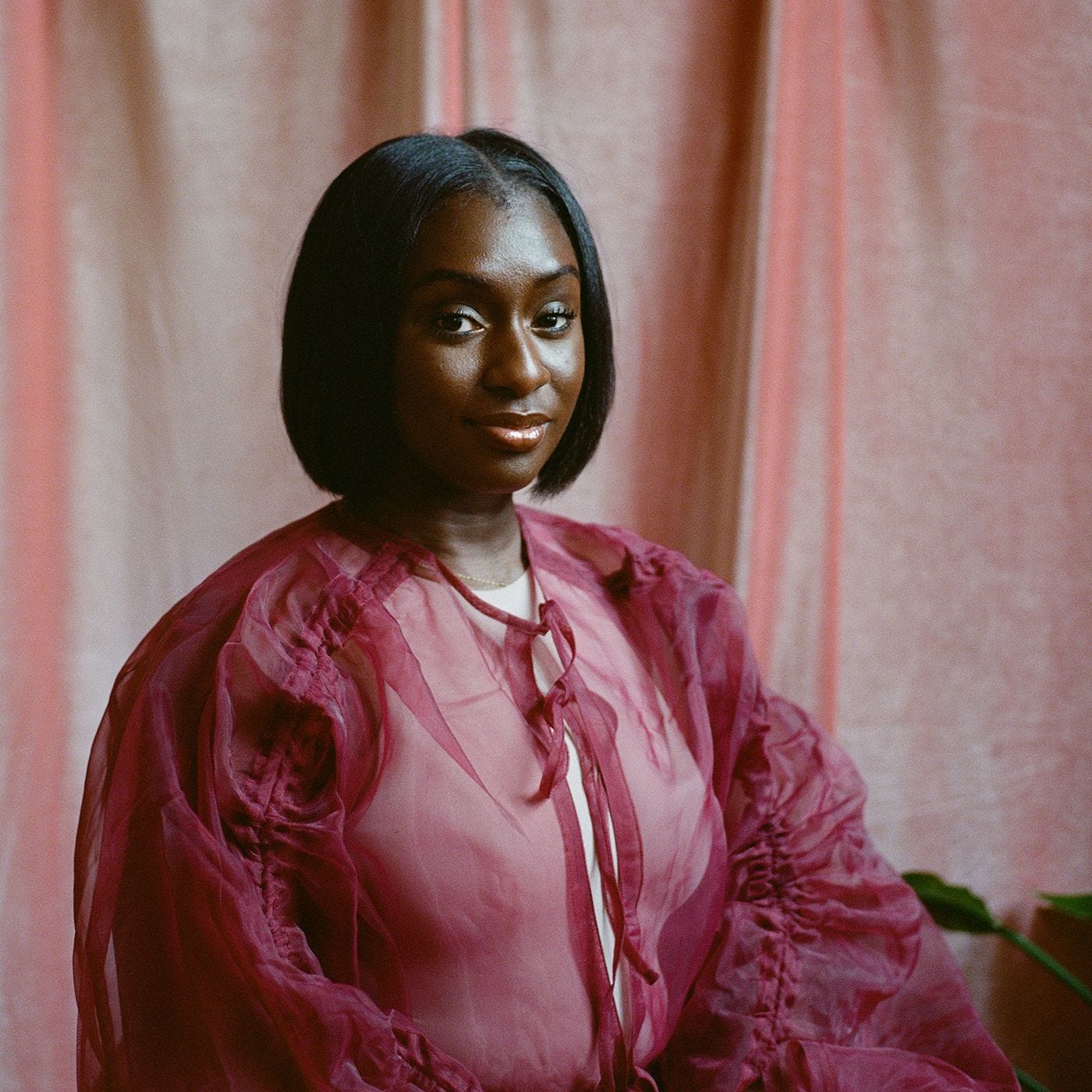
N’Diaye-Mbaye wrote about this directly in her essay for The Cut: “I couldn’t compete with the deep pockets of corporate brands; at retail stores, prime shelf space comes at a price, and we couldn’t afford it.”
Ami Colé’s roughly $3 million in total funding is a lot for a layperson, but a drop in the bucket for achieving success at Sephora. The cost of the inventory alone, scaled to 600 stores, with the kind of shade range an inclusive makeup brand is expected to carry, is enormous. Add the marketing spend needed to drive traffic to those stores, the PR, the influencer seeding, and the operational infrastructure to manage it all, and you’re looking at a capital requirement that most indie brands simply cannot meet.
N’Diaye-Mbaye also described how her attempts to grow hurt her: “We made operational decisions that felt necessary at the time, like scaling up production to meet potential demand, without truly knowing how the market would respond.” Stock levels became difficult to predict, as viral peaks caused products to sell out and then be overstocked.
This is the Sephora paradox for undercapitalized brands: you need scale to afford the shelf, and you need the shelf to get the scale. The math only works if you have enough capital to absorb the gap between the two. Ami Colé didn’t.
The Funding Cliff That Nobody Warned About
There’s a harder dimension to Ami Colé’s story that N’Diaye-Mbaye addressed with unusual candor.
In 2020, investors were talking a big game about equity and representation by pledging dollars, launching initiatives, and building buzz. Some of that capital was genuine. Some of it was performative “diversity investing” that was more about optics than the long-haul commitment that consumer brands require.
N’Diaye-Mbaye wrote that investor expectations had become “temperamental,” that some of the investors who had talked about “betting big on inclusivity” in 2020 changed their tune as years passed. The landscape changed considerably, with funding drying up for Black-owned brands and broader DEI rollbacks under the current political administration hindering institutional support.
Ami Colé raised $3 million total. Briogeo bootstrapped for six years before taking any outside capital and only did so after the business was profitable. The sequence matters. Briogeo earned its way to scale. Ami Colé was asked to grow before the business was fully ready, and then the capital environment that had encouraged that growth evaporated.
This isn’t a story about one brand failing and another succeeding. It’s a story about the conditions different founders inherited and how much those conditions shaped the options available to them.
What Every Founder Building for Retail Needs to Hear
Sephora is not the goal. Sephora is a channel. And like every channel, it has its own economics, its own margin requirements, its own marketing costs, its own expectations for velocity and growth. Going in underprepared or undercapitalized doesn’t just slow you down. In prestige retail, it can end you.
The question isn’t whether to pursue retail. It’s when, at what scale, with how much capital in reserve. Briogeo went in at the right time, with the right product, and enough personal commitment to survive the early years before the business could support itself. Ami Colé went in at a pace the business and its capital structure couldn’t sustain.
None of this is a criticism of Diarrha N’Diaye-Mbaye. She was handed a structural challenge, the expectation of rapid scale with insufficient long-term capital, that would have broken most founders. She turned $1 million into a brand that sold out its launch, went viral, won 80 awards, landed on Oprah’s list, and reached every Sephora in North America.
In her own words: “Don’t be afraid to fail out loud.”
The harder truth is systemic: the capital that rushed toward Black-owned brands in 2020 came with the same growth expectations as any other VC bet, without the same depth of patient support. And in a category as capital-intensive as prestige makeup, that mismatch was always going to be dangerous.
Both founders built something real. One had the runway to let it compound. The other was asked to run before she could walk, and when the runway ran out, there was no one to extend it.
The Lesson
If you’re building a consumer brand and thinking about retail, understand the true cost of the shelf before you say yes to it. Not just the margin economics. The marketing spend. The inventory commitment. The operational infrastructure. The capital you’ll need to compete for attention against brands with budgets that dwarf your entire raise.
Briogeo took nine years to get to an exit. Nine years of building, iterating, and earning its way to scale. That’s not a cautionary tale. That’s the whole point.
If this was useful, share it with a founder who’s about to sign a retail partnership without running the real numbers first.
New Article every Tuesday.
Be Bold. Be Real. Be Anomalous.