



If you’ve ever wondered why men and women seem to age differently, or why skincare marketed to each gender contains different products, you’re asking the right questions. The truth is, biological sex creates real, measurable differences in skin structure, function, and aging patterns. Understanding these differences is the key to caring for your skin effectively.
The Foundation: How Men’s and Women’s Skin Are Built Differently
Before we talk about aging or products, let’s understand the basic structural differences. These aren’t small variations—they’re fundamental differences in how your skin is constructed.
Thickness: The Most Important Difference
Men’s skin is approximately 20-25% thicker than women’s skin throughout most of life. This isn’t just about feeling different to the touch—it’s a structural difference that affects everything about how skin ages and what it needs.
Why this happens: Testosterone stimulates collagen production, creating denser, more compact skin structure. The result is skin that’s firmer, more resistant to damage, and structurally more robust.
What it means for men:
Skin feels firmer and more resilient in youth
Fine lines appear later than in women
When wrinkles do form, they tend to be deeper and more pronounced
Skin can tolerate stronger active ingredients better
Takes longer to see visible signs of aging
What it means for women:
Skin has a finer, more delicate texture
Blood vessels are closer to the surface (more visible redness)
More prone to dehydration and sensitivity
Fine lines may appear earlier, but are initially more subtle
Skin is more vulnerable to environmental damage
Oil Production: Why Men’s Skin Is Shinier
Men produce nearly twice as much sebum (skin oil) as women. This difference is dramatic and creates distinct characteristics for each gender.
For men, this means:
Skin tends to be oilier, especially in the T-zone (forehead, nose, chin)
Larger, more visible pores
More prone to acne, even into adulthood
Better natural moisture protection
Skin stays naturally hydrated more easily
For women, this means:
Oil production varies significantly with hormones
Skin type can change throughout the menstrual cycle
Many women experience increased dryness with age, especially after menopause
Oil production can fluctuate during pregnancy, stress, and other hormonal changes
The irony is that while men often complain about oily skin, that oil is actually protective. It creates a natural moisture barrier that helps prevent dehydration and can slow some visible signs of aging.
Women’s more moderate oil production means they often need to supplement with external moisturizers more consistently throughout life.
The Collagen Story: Different Timelines
Both men and women lose collagen as they age—it’s the protein that keeps skin firm and plump—but the timeline is dramatically different.
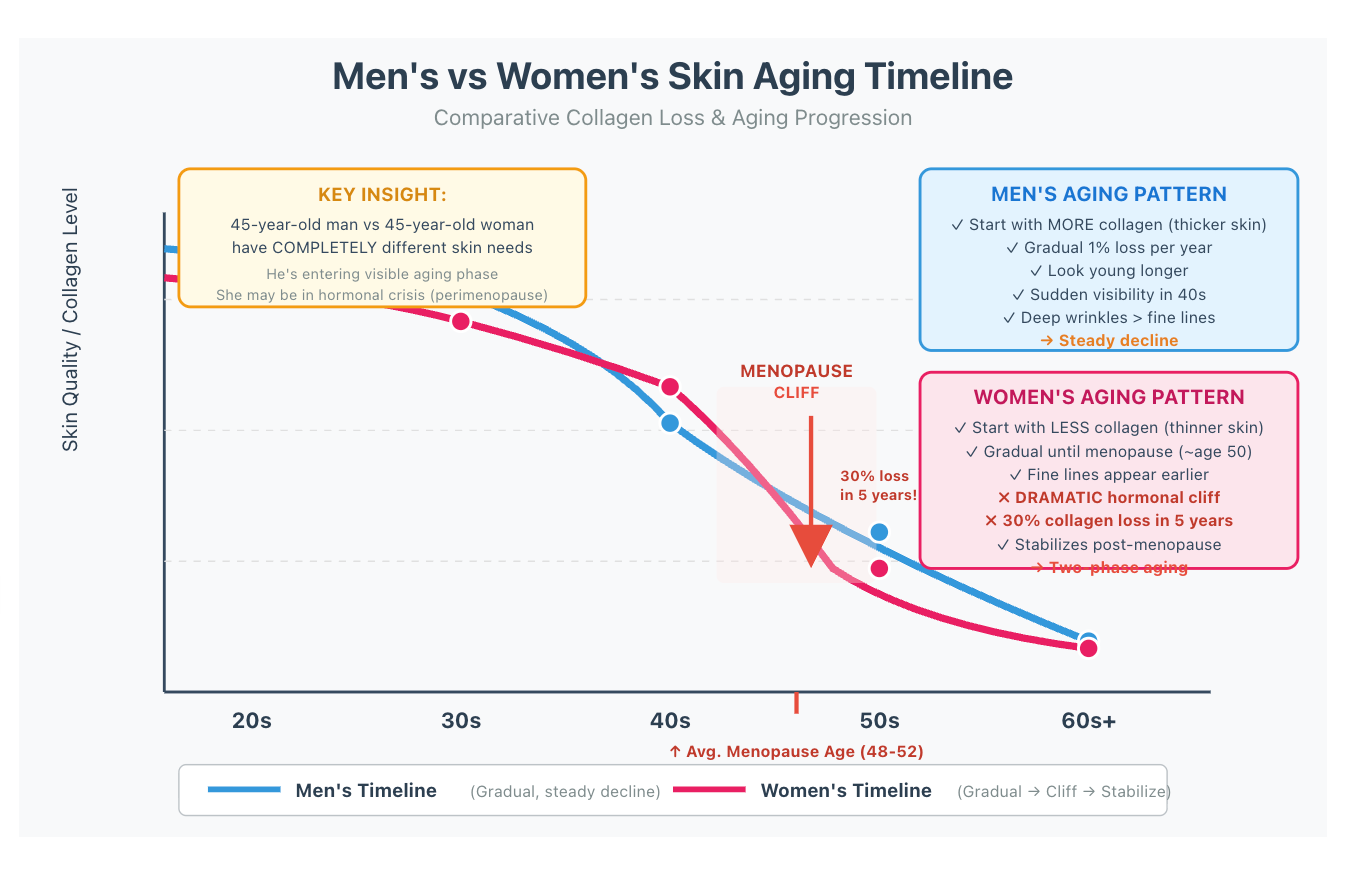
Men: Start with more collagen due to testosterone’s effects. Lose about 1% per year after age 30, steadily and consistently throughout life. The decline is gradual and predictable.
Women: Start with less collagen but maintain it relatively well until a critical point—menopause. In the first five years after menopause, women can lose up to 30% of their skin’s collagen due to the dramatic drop in estrogen.
This difference in timing explains why men and women often age on such different schedules. A 45-year-old man and a 45-year-old woman can have completely different skin concerns because of where they are in their respective collagen loss timelines.
How Aging Looks Different: The Timeline for Each Gender
Understanding how your skin will change over time helps you prepare and adjust your care appropriately.
Men’s and Women’s Aging Timeline
The Visible Signs: What Aging Actually Looks Like
In Men
Wrinkles: Deep, pronounced lines rather than fine, surface wrinkles. Most common in areas of repeated expression: forehead (horizontal lines), between eyebrows (the “11” lines), and around eyes (crow’s feet). These wrinkles often look carved into the skin.
Sagging: Becomes the dominant aging sign in later years. Loss of definition in the jawline, development of jowls, and sagging in the neck are particularly noticeable. The face becomes less angular and more soft.
Texture: Skin maintains relative thickness but develops roughness and unevenness. Large pores remain visible or become more so. Sun damage appears as dark spots, broken capillaries, and uneven tone.
Under-eye area: Bags, puffiness, and dark circles are common. The skin here becomes crepey and shows signs of fatigue more readily.
In Women
Wrinkles: Begin as fine lines and gradually deepen. More evenly distributed across the face rather than concentrated in expression areas. Common locations include around the eyes, smile lines (nasolabial folds), and vertical lines above the lips.
Volume loss: Hollowing in the cheeks, temples, and under-eyes creates a more drawn appearance. This volume loss is particularly dramatic after menopause and significantly alters the shape of the face.
Skin thinning: The skin becomes noticeably more delicate, sometimes taking on a tissue-paper quality. Blood vessels become more visible through the thinned skin, and the overall texture appears more fragile.
Texture changes: Skin can develop a crepey appearance, especially around the eyes, neck, and décolletage. Dryness creates rough, flaky patches that weren’t present in younger years.
Pigmentation: Age spots, sun spots, and uneven tone become more visible on thinner skin. Melasma (dark patches) can develop or worsen, particularly in areas of hormonal change.
What Your Skin Needs: Care by Gender and Age
Now that you understand the differences, let’s talk about what actually matters for keeping your skin healthy throughout life.
Skincare for Men: What Actually Works
Core Routine
Morning
Cleanser: Use a product suited to your skin type. Oily skin benefits from gel or foaming cleansers; dry or irritated skin needs a gentle cream cleanser.
Moisturizer: Even oily skin needs hydration. Choose a lightweight, non-comedogenic lotion; go richer if your skin feels tight or dry.
Sunscreen (SPF 30+): Apply every morning—rain or shine. Men’s thicker skin still suffers UV damage. Use a matte formula for oily skin or a hydrating one for dry.
Evening
Cleanser: Wash off dirt, oil, and sunscreen to prevent breakouts.
Treatment (2–3 times per week):
Retinol: Boosts collagen and prevents wrinkles. Start with 0.25–0.5% and increase gradually.
Exfoliating acids: Use salicylic acid (BHA) for oily or acne-prone skin, glycolic acid (AHA) for roughness or sun damage.
Moisturizer: Apply after treatments to lock in hydration.
Shaving Tips
Before: Cleanse and, if sensitive, apply a pre-shave oil.
During: Use a sharp razor and quality cream; shave with the grain.
After: Skip alcohol aftershaves. Use a soothing balm with allantoin, centella, or niacinamide.
Key Ingredients
Niacinamide (oil control, pores), Retinoids (anti-aging), Salicylic acid (clogs, ingrowns), Vitamin C (brightening, antioxidant), Hyaluronic acid (hydration).
Aging Focus
30s: Prevent—use sunscreen and start retinol.
40s: Increase retinol; add peptides; care for neck and eyes.
50s+: Maintain gentle, consistent routines and barrier support.
Skincare for Women: Adapting Through Life Stages
Core Routine
Morning
Cleanser: Water rinse if dry; gentle gel if oily.
Toner/Essence (optional): Adds hydration.
Antioxidant serum: Vitamin C or niacinamide protects and brightens.
Eye cream (optional): Caffeine for puffiness, peptides for firmness.
Moisturizer: Adjust texture to skin’s needs—richer with age.
Sunscreen (SPF 30+): Daily essential for preventing aging.
Evening
Double cleanse: Remove makeup/sunscreen, then wash.
Treatments:
Retinoid (3–4 nights): Start in late 20s; increase gradually.
Peptides: Support collagen, especially post-menopause.
Hydrating serum: Hyaluronic acid or similar.
Eye cream: Richer nighttime formula.
Moisturizer: Use a nourishing cream; seal with oil or petrolatum if very dry.
Weekly:
Gentle chemical exfoliation (AHA) 1–3 times a week and a hydrating mask as needed.
Key Ingredients
Retinoids, Peptides, Hyaluronic acid, Ceramides, Vitamin C, Niacinamide, AHAs.
Adjusting Through Life
20s–Early 30s: Prevention—sunscreen, retinol, hydration.
Mid-30s–40s: Maintain collagen—add antioxidants and moisture.
Perimenopause–50s: Support barrier, adapt to sensitivity.
Post-menopause: Focus on deep hydration, ceramides, and gentle care.
Hormonal Changes
Cycle: Oilier, breakout-prone skin in week 4; hydrate more in weeks 1–2.
Pregnancy: Avoid retinoids and strong acids; keep it gentle.
Menopause: Skin becomes dry and sensitive—rebuild the barrier.
Lifestyle Habits That Show on Your Skin
Sleep: 7–9 hours—repairs and regenerates.
Stress: Raises cortisol, breaking down collagen.
Diet: Eat antioxidants, omega-3s, and protein; limit sugar.
Smoking: Destroys collagen and dulls the complexion.
Alcohol: Dehydrates and worsens redness.
Exercise: Improves circulation and glow.
Common Mistakes
Men: Skip sunscreen, overuse harsh cleansers, ignore aging signs.
Women: Over-exfoliate, switch products too often, chase trends.
Everyone: Expects quick results, uses too many actives, or neglects consistency.
Bottom Line
Men’s and women’s skin differ biologically, but both thrive on the same fundamentals: sun protection, gentle cleansing, hydration, and proven active ingredients. Your skin changes with age—adapt, simplify, and stay consistent. The care you give today shapes the skin you’ll have decades from now.